Showing posts with label France. Show all posts

Friday, 27 March 2009

EATING; IS IT FOOD OR NOT? THAT IS THE QUESTION.

image People all over the world eat different foods, but when it comes down to it, there are only things from animals and things from plants. You may like chilli sauces, soy sauce, tomato sauce or a good gravy. You may season your food with salt or pepper or oregano or lemon juice or coriander leaves or rocket. You may like seaweeds and sushis or pate and caviar or lollies or vegemite. You may eat Mexican food or Japanese or Middle Eastern but they are all either of animal or plant origin. Even our drinks are just clever uses of plants. Do you drink coffee, peppermint tea or rooibos or even sake,  gin, vodka, wine, lemonade or, horror of horrors, coke? Whatever the case, it all originates from animals or plants.

Way, way, way back in time, people only ate what they could pick or grow or catch. Life was hard work and the human life span was often short but not usually because of what they ate. Usually death came through disease and lack of hygiene, hunting injuries or fighting. (The single most important cause of the increase in world population was the discovery of hand washing, to reduce the spreading of infection. Hand washing has saved more lives than every medication ever discovered, combined.) People knew what they were eating because it still looked like the raw ingredient until they cooked it.

imageWhat has happened in my lifetime, is that what a lot of western people eat has stopped being food. Or at best, is so thoroughly disguised and prepared for consumption that its origins have been long lost in packaging. Although a chiko roll or hotdog or a can of coke once had its origins in something plant or animal, it has been processed down to a piece of coloured, flavoured, preserved, and often deep-fried mass and remade into a shape and colour and flavour that market research has deemed attractive to consumers. Look at this photo I took in a French supermarket of thousands of tiny plastic pots different types of yoghurt etc.....where are the 1 kg containers? Not available anywhere.... and so many flavours.... I felt sick just looking at them. Better to make your own yoghurt.

A boxed, frozen dinner is the ultimate con. The picture on the box is usually of a hot meal. There is no way you can choose the product by feeling the freshness of a raw potato or seeing the colour of the broccoli and in some cases the ingredients have travelled from faraway countries and over long periods of time and cannot have any goodness left in them, never mind the numbers you will be eating to ensure its stays looking edible. You might as well eat the box. In a less extreme way we can take the example of steak. These days, in supermarkets, they are wrapped in plastic on foam trays, hidden under labels proclaiming their low fat content or advertising the supermarket's low prices.
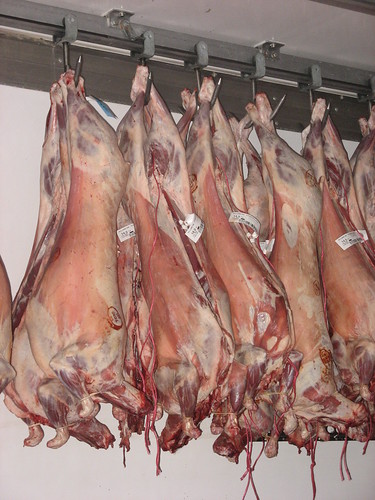
Meat is Murder by slabsofabsence.I remember, as a child, going into a butcher's shop with my mother to buy some T-bone steaks. Behind the butcher, on a rack stretching half way across the room, hung animals, undisguised, and from one of these the butcher would skilfully cut a section of meat. From here he would take it to a band-saw and cut the bones and then sharpen his knife and carve out 4 T-bone steaks, placing some more into the display shelf. They would be wrapped in paper and handed to you to put into your shopping basket. There was no doubt that this was meat and no doubt how it got to be on your plate for dinner. He would advise you how to cook it and tell you how long it had been hanging and where it had come from and I would learn about the seasons and their effects not just on growing vegetables but also on animals and on my dinner.

At school I learned about cuts of meat by studying posters depicting sheep and cows, mostly, carved up into sections, while they were still "on the hoof" so to speak. We learned which bits were for grilling which for slow cooking and which for roasting. You were expected to have skills to deal with food, to prepare it with this understanding and women, mostly, learned how to feed their families with real food. Mine was an old-fashioned school, I guess, but it stood me in good stead. That, and cooking with my mother. Show me a 15 year old today who would know much about where milk comes from, let alone which part of a sheep their microwavable, marinated shasliks, vaccuum sealed to keep their freshness, came from!

What about preservatives and all those numbers that you see on packets of processed foods? And medications and dietary supplements? Some of them are processed as an extract from a plant, and concentrated then made into a pill or a powder or a liquid. A lot of medications start as an extract of a plant or even animal in its testing stage and then some are synthesized, or artificially made, whatever that means. Usually I would say go and eat a decent diet and forget the supplements. Asian medicines seem to only use the original organism and this causes not only the depletion in the numbers of wild creatures but also a wastage of the rest of the organism. For example, millions of sharks are killed for their fins and often the rest of the fish is thrown back to sea, such is the lure of getting more fins and therefore more money than can be gained from shark meat. I doubt whether anyone buying shark fin soup, however, in a western country even thinks about where the shark's fins have come from.

My rule of thumb is only buy raw ingredients and avoid anything that comes processed but if you have to buy things like dried fruit or breakfast cereal, buy one ingredient at a time. For example, when I buy sultanas I do not want sulphur to make them dry faster or oil to keep them separated or preservatives or a resealable, heavy plastic bag. I buy plain, sun or air dried sultanas from a shop that sells them in bulk and put them in a jar when I get home. The fact that I can get them locally grown and organic, for a good price, from a local shop (or from my garden or a friend's) is a bonus for me. As for breakfast I don't eat cereal much but I prefer to buy oats and other grains, nuts, sunflower seeds and dried fruits and mix them myself. Most of these things are produced in South Australia. It is different for other places but I would use whatever grows nearby in preference to buying something readymade.

image


If we all do this, the world will be a better place.... of course I do make exceptions.... this walnut tart was superb!

French patisseries....oh la la la....

Saturday, 28 February 2009

THE AFTERMATH OF THE TEMPEST

image We went for a drive to Arcachon which is on the Atlantic coast,  2 hours southwest-ish of Bergerac, south-west France. It was a beautiful sunny day for a picnic and a walk on the beach. The tempest or hurricane that lashed south west France a few weeks ago had come in from the Atlantic at about this position on the coast and the devastation is everywhere still. Whole forests of large pine trees are lying broken in half or ripped from the ground, leaving a few lonely specimens to show what was previously hundreds of mature trees. image

All along the roads and in people's yards and on every piece of vacant land now stand piles of logs, ranging from over half a metre across, down to kindling size.


These major roads were closed for days because so many trees had fallen across them and many now lie alongside the road, awaiting the chainsaws.

In the photo below there are many rootballs of fallen trees, as far as the eye can see, and not much else.
image
   image


Tears of sap.


Near Arcachon is the tallest sandhill in Europe, La Dune de Pilat, at over 100m high and 3km long.image And along the coast are miles of beautiful, white beaches.


Those who were not out dealing with timber today, were preparing the soil in their vegetable gardens for the new season. What a place France is for growing food! Everywhere, people were outside enjoying the sunshine and working in their plots. Many are warming the soil with small, plastic cloches. Some are hoeing weeds or preparing seedling beds. What a sight all they will be in a couple of months, full of tomatoes, capsicums, lettuce etc for the enjoyment of a great percentage of the families of rural France.

Wednesday, 25 February 2009

HOW LOCAL IS LOCAL FOR YOU?

Lots of us try to buy local but I have been thinking about this while I am in France and comparing it to what I know of Australia, or really just South Australia. Keep in mind that South Australia is 1.5 times larger than France in area but France has 40 times as many people!

For me, in SA, local means a few things. First, it means from a friend or producer very close to my house. Next it means within about 100km, like the oats Andrew wrote about. Thirdly, it means in the state of South Australia, and finally it means in Australia. I have even added the idea of local including Asia, at times.

Most of the food I eat at home comes from my garden or very near my home - such as fruit from my mother and vegetables from growers like Tony Scarfo at Virginia. Most of the dairy and grains I buy come from the 100km zone, and from Paris Creek Dairy and Four Leaf Milling in particular. Most of the seafood and wine I buy comes from somewhere in South Australia and most of the rest of the things I buy, like bananas and toilet paper and seeds and other bits and pieces are grown or made in Australia. I included Asia when I was thinking of rice, coconuts and soy sauce etc. In Europe, these things come from the African continent.

France is divided into 96 departments, all numbered in alphabetical order (which makes looking for them on a map very difficult!!). (This is like dividing South Australia into nearly 150 little areas). Every food item you buy has the number of its origin prominently displayed. This area, Dordogne, is number 24, and nearly everything I have seen at the markets has this number or 47, Lot et Garonne, the next department to the west and actually where the market is situated. Although things like oranges, this time of the year, are clearly marked 'from Spain', which is the next country but only 2 hours away! Even the milk bottles have this information in number form and I just noticed that our current bottle of milk comes from just 2 departments away to the south.

I love France's system of identifying small areas by number or name, and in France everyone seems to want as local as possible because it is the custom to believe that the best of everything comes from your local area and the farmers over the hill or on the other side of the next town just don't produce goods of the same quality as the farmers nearest you! And produce from several departments away ... well.... it might just as well be from Mars! Of course this wouldn't work in the same way for South Australia because so much of it is arid.

We are very lucky in South Australia to be able to grow most things, from vegetables and fruit to milk and grains, grapes and seafood. I cannot understand why the SA government does not encourage the state to be as self-sufficient in food as possible. Instead they cut the growers' water allocations but do not cut water allocations to any other businesses in the whole state!

Saturday, 14 February 2009

WHITE

Overnight it was - 3.5C and clear so there was a lot of frost this morning, the most since I arrived. I went out to take these photos at about 9am, when it had warmed up to - 2. Crisp is a word I have often used about chilly, fresh morning air but never has crisp felt like this to me before! It is beautiful.... not as beautiful as snow but still a lovely thing to see what patterns nature has been designing during the night....

image image
image
the orchard and beyond
image
broad bean leaf
image
the grass
image
the rear view mirror
image
Interesting to see how some plants, such as broad beans and garlic can cope with being frozen but others would die at these temperatures.

There are more photos here...
Meanwhile in Oxford,UK, son Alex and friends spent the day building Oxford's first igloo!!
image


image

Saturday, 7 February 2009

FUNNY THINGS ABOUT FRANCE

image

On Tuesday, we went to a lovely market in the streets of a village nearby, Castillonnès, on the top of a hill. There were people with stalls, selling their vegetables, fish, meat, plants, flowers, cheeses etc. It was freezing and I had on 3 layers under my ski jacket, and a scarf and gloves and I was almost warm enough! I bought a chicken to cook and it still had its neck, head and red comb imageattached and came with a little bundle of gizzards. Very French, evidently. 


Vegetarians beware!

We have discovered celeriac, which I often see in the Adelaide market too - you must get one to try. It is an ugly, knobbly thing but you can cut bits off, like a pumpkin, and roast them and they are really, really delicious. You can also grate it into a salad to eat raw which is also nice. It lasts for ages so you just keep cutting bits off when you want to. I also have really enjoyed endive.... a kind of stem and leaf veg like spinach, that they grow in the dark and it goes pale. I dug them at Roger D's place in Maine. We roasted them in the pan with the celeriac and pumpkin etc and I thought it would dry out but Ian assured me it would be ok and it was much better than ok - it was fabulous.

Then, there is blette, which we learned from the dictionary is Swiss chard. It is like a short, fat version of silver beet. I am going to make spinach and fetta pie tomorrow.

One funny thing is that it is hard to get raw beetroot - it is always sold boiled, on the vegetable stalls. You can get the large, round ones or large, long ones but they are nearly always cooked.

One of my favourite blue cheeses is St. Agur, which son Hugh first told me about at the Adelaide market. It costs about $75 / kg there but you wouldn't believe the price here! Ian buys a kilogram of it at a time and freezes it in pieces. You only need a little. It is less than $30 / kg and you can get it at the supermarket!! There are lots of other beautiful and reasonably priced cheeses here too and it is very difficult not to eat too much. So much local stuff is available from the supermarkets, it is very good.

There is a local baker that drives around this area twice a week, selling bread from the back of the van. We bought 2 croissants and a baguette and they were still warm. The croissants are a bit smaller than in Adelaide and generally straight, not curved, and very good. I am trying to avoid going anywhere near a patisserie until I lose a few kilograms but I do love the croissants, which come from bakers not patisseries. And the chausson au pomme..... a kind of pasty shaped, apple filled croissant.... perfect with a noisette, which is a short black coffee with a dash of milk. You can't get flat white so I am now getting used to noisettes, and sometimes they bring it with a little jug of hot milk extra , which is great.

image This morning at the Villereal market it was icy cold but sunny and I was not even nearly warm, even with a woollen spencer, long-sleeved shirt, woollen jumper and my ski jacket, scarf and gloves! So we bought our chausson au pomme (for me), pain au raisin (sultana croissant, for Ian) and then Ian bought this thin paper-wrapped tube of crepes. We took them to the bar/cafe in the market square and had our noisettes inside in the warm. This is what they do, buy food from the boulangerie (bakery) or patisserie (cake shop) or pizzeria or from the hot chicken stall and then take it to the bar/cafe and eat it with your coffee. The waiter sometimes calls out 'Bon appetit', even though you didn't get the food there and will bring you a plate and hot handtowel, if like me, you get in a mess with your chicken! The bag of crepes was just that..... a bag of cold, soggy,very sweet, rolled crepes, that felt like long, fat worms.... yuk! The first French thing I haven't liked at all.image

You have to be quick to get your goods from the bakeries / patisseries / sandwich shops etc because  even they close for 2 - 3 hours every day for lunch....well, you can't expect to buy lunch at lunch-time can you?? The supermarkets and all other shops except restaurants close for lunch too. Restaurants and cafes won't serve you though, if you don't get there by about 1pm. Why? They need time to enjoy their own lunch break, of course! Only foreigners would dare ask for lunch out of the time slot 12 - 1pm or soon after. Food is a serious business in France.

image


On Thursday we drove through the pretty countryside, dotted with farm houses and sprinkled with fields, edged in hedgerows to Monflanquin. It was about 12.30 by the time we got there and of course everything was shut but the streets were nice to just wander about. One shop (above, right) in this tourist village opens only from 10.30 - 12.30 then 3pm - 6pm. Another sign sat (left)  prominently on the footpath and it said in French "Due to a general lack of interest, tomorrow will not take place" !! OK, so do we all jump forward a day or what?? Yeah, lets give Friday a miss this week.... who needs it?

image


There are more photos here.

Sunday, 1 February 2009

FROST, ICE AND TEMPEST

While you are all suffering with the shocking heat, I am here in southern France in winter. I wake each morning, throw open the shutters and see a field of white frost and often a cold mist hangs over the garden. Yesterday I went to empty the wheelbarrow into which I had put some soil from another part of the garden the day before. Something glistened and I thought it was odd that I hadn't noticed a sheet of glass in the wheelbarrow.... it was ice, of course!

image The day after I arrived, a tempest blew in from the west, shaking the trees, the roof, in fact the whole region, with winds in excess of 180km/hour! It blew for over 24 hours and cut all electricity and phone lines, killing 4 people. Trees were down everywhere, rooves were torn off and rivers flooded with the rain. We had no electricity for 6 days.... most of the local shops were shut, none could take credit cards but neither could the banks give out any cash, so getting anything at all was almost impossible. With no phones or mobile reception it was quite eerie and news only travelled in through visitors. Some places had no water either. Even the markets did not open as stall holders could not bake bread or or make other goods and some had so much damage their vegetable crops were destroyed. Here you can see Ian's pool shed blown over against the pool. Finally power was restored, the sun peeped out and people went out to assess the damage.

imageToday the thermometer hit 14C and I took off one of my many layers of clothes! Previously it has been between -2 and +6C.  We went to the Villereal market where most but not all of the producers had returned at least with some produce. There were some cardoons for sale today and also salsify, which I am unfamiliar with.

image


It was great to sit and watch the people, while having a noisette..... a short black coffee with a dash of hot milk.... my new flat white, and a chausson au pomme.... a kind of apple turnover with croissant-like pastry. Delicious! Next time I will take a photo.


image On the way home we called in to the tiny hill-top village of Eyenville, where the local source is situated. I love these springs in France, where water trickles from a rocky cave and people come to collect the purest water imaginable. This one happens to be set in paradise.....you can just see the little cave in the centreimage of the photo at left.


The reasons why I am here are complex. But for the moment lets just say I am a Hills and Plains Seedsaver staying in a Kitchen Garden in France and writing about life in rural France.