Showing posts with label Food for health. Show all posts

Tuesday, 8 February 2011

Crunchy Summer Green Bean Salad

Green Bean Salad-7

Summer crunch for lunch, straight from our garden.  Blanched green beans, green peppers, tomatoes and crispy red onions tossed with fresh garden herbs, olive oil and cider vinegar. YUM!

Makes all the seed saving, nurturing of seedlings, preparing garden beds, planting and watering worth the time and effort.   

Wednesday, 26 January 2011

Cucumber Gazpacho

Cucumber Gazpacho-11

Summer garden produce is finally ripening in our garden.

We are starting to pick tomatoes and today picked 2 Richmond green cucumbers.

So along with some fresh basil, garlic, chives, mint, red chilli, parsley, salt, pepper and a little water we blended 6 tomatoes and our peeled cucumber into this delicious cold soup which I have called cucumber gazpacho because of the delicious fresh cucumber it had.

All the herbs and veggies were freshly picked and we enjoyed the soup sitting in the garden watching heaps of bees enjoying flowering herbs and busily pollinating the plants in our garden.

LOVE!!! Summer so far!

Friday, 21 January 2011

Middle Eastern Spicy Chickpea Salad


Batty's Garden-58

Today we had lunch with some friends so I made this delicious salad.

I always use organic dried chick peas, soak them overnight, drain them and then simmer them in fresh water until tender then drain them.

When cooked I sprinkle the chickpeas with salt, cracked black pepper and a little paprika and olive oil.

For this recipe I heated a couple of Tablespoons of Middle Eastern spice mix in a little oil to infuse the flavours.

I added this to the chick peas with some finely sliced red onions, the juice of 2 lemons, some chopped tomatoes, chopped cucumber, a dollop of tahini, a handful each of chopped mint and parsley, more black pepper, paprika and crushed garlic.

I served it on a bed of wild rocket.

It is great to have all these lovely herbs in the garden to flavour your food.

Most folks brought summer produce from their gardens including eggplant dip, zucchini fritters, tomato and basil salad and cold rolls filled with home grown veggies and herbs.

All these dishes make delicious, healthy, summer salads or vegetarian mains.

I was going to say I love summer garden produce, but then I love winter produce just as much. Whatever season it is there is always something to make flavourful meals with when you grow lots of vegetables & herbs in your garden.

Monday, 13 December 2010

Spinach Soup with Leeks, Garlic, Black Pepper and Pizza Thyme.

Sometimes you cook something which is absolutely delicious.

After a busy day I went into the garden to find lots of spinach ready to be cooked and eaten.

I felt too tired to make spinach triangles and as it is a cool rainy evening soup seems very appealing.

So I blanched some spinach, drained it, added some cooked baby leeks, black pepper, chopped new season garlic, salt, a little cornflour blended with some milk and a handful of pizza thyme.

I cooked this gently for a few minutes then pureed the mix.

I served the soup with a dollop of sour cream and voila! an amazing delicious, nutritious soup.

All fresh from the garden and more delicious than most soups I have tasted.

Spinach Soup-6

Friday, 30 July 2010

TIME FOR THYME!

It is winter in Adelaide, it is cold and wet and lots of folks have coughs and colds, so it is time for thyme.

Thyme is a great addition to your medicinal herb garden.

Thyme contains thymol which you will find in toothpastes and throat gargles.

Thyme, honey and lemon make a great soothing mix to sip if you have a sore or dry throat.

Infuse some thyme in green tea, add a little honey and you have a great tasting herbal tea.

Thyme has great antiseptic properties as well as aiding digestion and boosting the immune system.

And thyme tastes great!

Combine thyme with other herbs such as sage and rosemary and the uses and health benefits of using these herbs is amazing.

Thyme is used in equal quantities with sumac to make Zatar which is used in Middle eastern cookery.

Thyme is used with cumin in Cajun cookery.

Thyme, parsley, bayleaf is tied in a bundle to make a bouquet garni which is then added to most French stocks and casseroles.

Thyme is a great herb to include in your cooked vegetable dishes, meat and fish casseroles, soups, baked goods, egg and cheese quiches, veggie and tofu burgers, salads and salad dressings.

In fact thyme goes with just about every ingredient I can think of that you have in the kitchen.

The many varieties of thyme enhance you food with different flavours.

We even add thyme, parsley, sage and oregano to our dogs raw food diet.

Herb Garden

Friday, 25 June 2010

K is for Kale, F is for Fenugreek and C is for Coriander and Chilli.

Picked straight from our Adelaide winter garden, sautéed with some garlic chives and local olive oil and then added to freshly made organic chicken broth.

A real good bowl of healthy fast food.

IMG_0017

Thursday, 25 March 2010

Turmeric flowers and leaves

Turmeric flower and leaves

One of the loveliest surprises this year in our summer garden was the beautiful flowers on the turmeric plant.

Dried and fresh turmeric root has amazing health properties so we look forward one day to harvesting some delicious turmeric root to add to our curries, soups, veggie burgers and vegetable pates.

Now if you want to read more about home harvesting of turmeric and ginger please check out Julie’s blog Towards Sustainability.

Julie lives in Newcastle New South Wales and if you check out her blog entries for Ginger harvest Saturday July 4 2009 and her entry for her Turmeric harvest Thursday July 2 2009 you will be amazed at her harvest for last year.

I reckon Julie is a garden hero!

Saturday, 27 February 2010

THE ANSWER TO THAT QUESTION.... HOW TO FEED THE WORLD

There you have it.... and it was obvious all along but I just couldn't put my finger on the link.... I must be getting old....or something!

Monoculture means growing one thing, usually on a massive scale and killing everything that dares interfere with that one thing, with chemicals.

Then there was organic but often it came to mean growing one thing, on a massive scale and killing everything that interferes with it, with chemicals made from natural substances.

In the organic vegetable garden I always encourage people to make use of every little microclimate, interplanting tall things with short to get shade in the heat of summer; always having flowers and seedlings and mature plants in the same bed; feeding the soil and the plants will feed themselves..... but still I was not quite sure what to say when asked "How can we feed the world this way?"

But then there was "Fresh" the movie.... and I have the answer... its all about food being nutritious and the loop....

Monoculture is like a huge field of wheat; when the crop is taken, there is nothing left. The farmer must get the land ready for next year by fertilising, spraying for pest and weeds, fixing machinery and buying seed. He spends many thousands of dollars on inputs from all over the world, which are trucked and shipped and give me a headache thinking about. Lets say that after expenses, he makes $100 / acre for his wheat crop if it is a good crop and if prices are good.

Then lets look at the kind of farmer shown in "Fresh" who has several fields of mixed grasses which soon self seed every year. First he puts cows on the field. Cows eat grass and grow big. Every few days he moves the cows to the next field, then the next and so on around the property. As the cows go along they fertilise the grasses but they also attract flies which lay their eggs in the dung, and flies carry diseases which can quickly spread through the cows when they come back to this pasture. Eventually he sells the cows for meat, to a local butcher. It is organic and of excellent quality and he might get $100 / acre. His cows had calves and so his next generation is produced.

Second,  3 days after the cows are taken off he lets in the chickens to the first field. The fly and other insect eggs have hatched and the chickens are in rapturous delight and gorge themselves, laying big, healthy, nutritious eggs for the farmer to sell. From these large, organic eggs the farmer receives $100 / acre from the local organic food shop or from the farm gate. Some of the eggs are allowed to hatch and become the next generation.

Third, in come a host of meat birds that eat a different selection of grasses to the cows and the chickens. Once these birds such as geese and turkeys have been through all the fields, they are sold for meat. They are healthy and strong and organic and he might get $100 / acre, sold direct to local shops. These also reproduce themselves.

Fourth, the grass is now well fertilised by cows, chickens and other birds and grows fast. The cows are allowed back in again before the grass dries and goes to seed. Now the farmer cuts it for hay. He uses some for the bedding and winter feed for his animals and sells the rest. He might receive $100 / acre from local people direct from the farm. The grasses self-seed and come up again next spring.

Moreover, some of the fields of the sustainable farmer produce a variety of vegetables at various times and some may have fruit trees under which the chickens graze in their rotation. The system is flexible and is a closed loop, with few inputs from beyond the farm. All his produce is sold locally.

Even with this simplistic view, you can see that he is producing many times the volume of more nutritious food for human consumption than the wheat farmer, whose crop is shipped around the world where it is processed and made into white flour which ends up as items wrapped in plastic bags in supermarkets thousands of kilometres away, adding little but carbohydrate to the diet to those that eat it. And it seems, from the documentary, that the multi-cultural farmer reaps the rewards financially too.

The multi-cultural farmer needs workers to help. He creates employment for locals. Those who may otherwise be driving trucks or ships of wheat, stay home and work on this farm and themselves learn the value of nutrition, raising healthy children who take their message to school and help start a school vegetable garden..... and so the effects go on and on, rippling through every avenue of society.

In this way we not only feed the world but it is sustainable, reducing greenhouse gases, climate change, pollution, medical expenses, unemployment  etc etc etc and generally making the world a happier place for everyone.

Watch a trailer, join the movement, find a screening here. It is American, and I am always sceptical of American things (sorry Pattie!) but this is genuinely good and farmer whatsit who lets his chickens be chickens and develop their chicken-ness is fabulous..... as is the big, ex-basketballer turned urban farmer.

Wednesday, 24 February 2010

HUGH'S PATCH.... YOU WON'T BELIEVE IT NOW!

If you have been following the story of my son Hugh's garden, you will know that he started with a yard FULL to the brim with concrete about 18 months ago. I got the phone call to please come and help start a garden one morning and was told to bring wheelbarrow,tools and compost! Of course I was keen to see him start to grow vegetables so of course I obliged and by the end of the day he had a little area about the size of 2 dining room tables to plant into. For some months I received frequent phone calls from an excited Hugh telling me his first tomato was ripe or his lettuce was being eaten by goblins at night or asking was it the right time of the year to plant beetroot or bananas! Every evening after work he would sit out beside his patch while having a beer and gaze in wonder, like a father with a baby. It was not a big enough area for two people to sit next to easily, and one day I had another phone call. When I arrived, this first photo shows what we had to tackle to make a second bed. This is the story of the evolution of this bed....

image 


April 2009.... oh hell !! It was a rough delivery for the second baby but sand is, at least, easy to dig!
image
Leaves flourished and Hugh was proud... 
image
image
February 2010...a new plan hatches one fine summer's morning... construct an edible water garden, with style...


image


This very morning we finished it and I must say it is a wonder to behold and a delight to sit beside and music to my ears to hear the tinkle of water trickling off the rocks into a pond planted with watercress I originally received from Deb and water chestnuts originally from Cath.

The edges will be filled with lettuces and herbs and you can see a few young amaranth on the left which will give shade in the late afternoon when they grow. There are some tubers of cardamon behind the rocks, and although they don't flower here, the leaves can be used to wrap fish or vegetables, for a fragrance like lemony cinnamon.

The water is still murky as we had only just retrieved one of the large rocks that toppled into the pond while we were adjusting the water pipe!

It certainly goes to show that gardening is all about observation, inspiration and determination!

Friday, 12 February 2010

Comfrey and watercress and a cancer theory

HERBS ARE SPECIAL......


There is a lovely Australian website and blog for lovers of all things herbal. It is Isabell Shipard's Herbs Are Special. It explores every herb I have ever heard of and lots more, in depth, and son Hugh sent me a link to the page about comfrey, which has from time to time been given a rough trot. Maybe, like many another theory, comfrey is about to have its name cleared and become the latest wonder herb, as it once was. Being a lover of leaves and knowing how easy it is to grow comfrey I would love to start eating it too....well, actually I put it in last night's dinner. I know chooks love it and I have fed it to mine for years. It would be interesting to know what readers think.

....Read the book, ‘World without cancer, the story of vitamin B17’ by Edward Griffin, which reveals how science has been subverted to protect entrenched commercial and political interests. The book explores the revolutionary concept that cancer is a deficiency disease, the substance missing being B17 (also called laetrile), discovered by German chemist Leibig in1830, and further researched by Dr. Ernst Krebs and others.

Another Australian, who valued the HDRA research, was Foster Savage, who I mentioned earlier. I had the opportunity to know him, personally, when he settled in Nambour to farm (and later Cooroy); and, I knew you would guess, he grew lots of comfrey! Wilted comfrey was fed to his animals in large amounts. Why did he allow it to wilt? He told me that animals could eat much more, each day, when it was wilted! He often had groups and private people visit and he would, freely, share his knowledge of comfrey and how it benefited his land, animals and his family (note, he had 13 children). When legislation placed comfrey on the poisons schedule in Australia, and newspapers highlighted the ban, he wrote a letter to the Sunshine Coast Daily, in defense of comfrey, saying:

"I was perhaps responsible for 95% of the comfrey in Australia, having introduced the plant to this country in 1954, and having used the plant in great quantities, since then; I am, perhaps, competent to speak about it and to make a few comments on the …remarks about comfrey made by the CSIRO scientist …"To say that two leaves, eaten daily - over a couple of years - will cause serious disease, is simply not true. In our house, we have eaten 70 leaves, or thereabouts, daily, for 24 years: in the form of comfrey tea, liquidised in a vitamiser as a green drink, and in salads. I also fed comfrey to my farm animals.

Knowing the power of comfrey to restore a worn out animal quickly, and make her milk again, I once bought an old cow at the Dandenong Market, when farming in Victoria. It had been discarded by some farmer, as worn out. I put her on comfrey, giving her 90 lbs of wilted comfrey (wilted to increase the cow’s intake of comfrey’s extraordinary nutrients), and 90 lbs made a pretty big heap, about 4 feet high. This poor, old, creature took to the comfrey, without hesitation … she was starving for minerals and her instincts gave her a craving for comfrey. When she began to eat, she would eat off the heap of leaves for a couple of hours, then sit down for an hour or so. Later, she would continue eating, until every leaf was gone. If Dr. Culvenor’s words were true, imagine the poison she would be taking into her body, with this quantity of comfrey daily. If comfrey attacked the liver, then this cow would have died, because she was in a worn out condition. Instead, she doubled her milk output, within a week, and in a fortnight, trebled it. The remarkable thing, was that the cream that settled overnight, was some 3/4 inch thick and the separation of cream from the milk was so perfect, that the cream could be lifted off, with none remaining. I fed comfrey to calves, as much as they could eat, again with only gratifying results. I fed pigs, entirely on comfrey and grain, as much comfrey as they could eat, and the quality of those pigs was legendary, in the district.

The fame of comfrey spread far and wide, for my farm was visited by 6,000 farmers from around Australia and from overseas. Finally, I well remember the enthusiastic remarks of the butcher who regularly killed our comfrey-fed calves. He told us that he had never before, seen such healthy livers … that, mind you, after being reared on a herb that was supposed to cause liver diseases!"

 Watercress is one of my favourite salad additions and the information on this website about its properties makes me glad it is also very easy to grow in a tub of water. You can give it a haircut daily and it seems to grow back overnight in summer!

You can buy herbs, vegetables and fruit trees and seeds from them too....http://herbs-to-use.com/herbs-for-sale/trees-fruits-vegetables-legumes-rare-edibles.html. I will put their link in the side bar, under seed companies.

Picking Herbs To UseYou can visit the Shipard's Herb Farm, which is in Queensland:

139 Windsor Rd., Nambour.
(on right, past Sunshine Coast Institute of TAFE)

Open hours -
Monday, Tuesday, Thursday and Saturday - from 10:00am till 2:00pm.

If you would like to come at any other time, please phone during open hours a day or more in advance to confirm a time when you would like to visit.

Phone No. -
(07) 5441 1101

Fax No. -
(07) 5471 6430

email -
info@herbs-to-use.com

There are no blog entries after 2008..... shame... but you can subscribe to email updates from Isabell.

Wednesday, 10 February 2010

AMARANTHUS FOR DINNER

image A couple of months ago I suggested you sow amaranthus..... so.... did you?

If not then you won't be looking daily in awe at this beautiful, tall, elegant, hardy, colourful, nutritious, tasty, versatile plant now beginning to wave wonderful, vibrant flower heads in the breeze! And, unless you buy it from the Asian stalls in the Central Market, you probably won't get a chance to have it for dinner until next year.... or if you are in the northern hemisphere, you'd better get some seeds and start sowing.

I am addicted to leaves; I have written about it before several times. Raw or cooked leaves are almost always a part of my meals. In summer this means lots of variety in my salads.... every kind and colour of lettuce, peppery watercress, fiery or mild rocket, nasturtium flowers and leaves, sweet potato leaves, herbs like basil and various mints, young beetroot leaves, baby spinch, Asian greens of dozens of sorts and new leaves of amaranthus, etc etc. For cooking I use the older leaves of all these plants, plus kales, brassica leaves and rainbow chard. I even adore lettuce soup which is so much nicer than it sounds!

Tonight I made a quick meal with onions, zuccini slices, tomatoes,celery, fennel seeds ( another passion of mine), olives, tinned chick peas, basil, watercress and some left over liquid from a small jar of artichokes I ate for lunch.

Most of these ingredients were eaten within half an hour of being picked....I call food gardens health insurance.


image image image
How could you NOT want these in your garden? Just chop some of the leaves and add to anything... the flavour is mild And don't forget to have a tub of watercress to pick from too.


FlippyOh... did I mention that I felt so great after that dinner that I made myself an incy wincy little fluffy, banana pancake for dessert and topped it with lashings of maple syrup, a dusting of coconut and a good squeeze of lemon? I cooked it and ate it before I remembered to take a photo... so I thought I'd let this little dude show you how its done!

Life is good.... enjoy it while you can!

Tuesday, 19 January 2010

Hugh's tomatoes, mostly

I guess there are a couple of good things about Hugh's garden being so incredibly windy and one of them is that no fungus could ever land here! Someone, probably me, needs to write down what does and does not like growing in windy places in our Mediterranean climate. Beans don't seem to like it at all and the poor zuccini plants are struggling to just stay put but the tomatoes are quite happy, having developed very strong trunks and limbs in order to survive their tall growth habits. Hugh is of the mind that says let them tough it out, don't pander to your plants.... and in his garden anything not able to thrive in the conditions is pulled up and thrown in the compost bin.

image image


Well, it seems to be working because these tomatoes have each set full hands of fruit,  up to 20 per length, as you can see at left, and there is also a bunch of more than 50, in various stages of ripeness, below.


image

image


The Tigerellas are doing really well too... in fact all except the roma are.... and guess where the roma is now! It has made way for more basil and  capsicums! Hugh grows herbs densely between and even under the tomatoes and it is so nice to be able to go out and pick such a variety of fresh herbs for a meal. He prunes off all the lower leaves of the tomatoes to keep them away from the soil, to reduce any diseases. We are also daily picking and cooking the bigger leaves of the amaranth, adding them to soups, vegetable combo dishes and pasta.

The amaranth is now nearly head high. It is not too late to sow amaranth... please, if you are in the southern hemisphere, sow it now and enjoy eating the leaves right through late summer and autumn, and then you will be rewarded with long flowing tassels of brilliantly coloured flowers followed by seeds.


image

image

We put the amaranth in the middle of the salad garden so it would shade the soft thing, like lettuce and the new leaves of the rainbow chard, during the heat of the day and this works well as amaranth, like okra, loves the heat.

One of the sunflowers has found something to rest on when it is windy ... the end of the clothes line.


image


All this talk of food made me realise it was lunch time so I had a plate of left-over vegetables, plus a bit of this crocodile pate, made here in Adelaide from crocodiles farmed in the Northern Territory. It is more delicious than you can imagine and much lighter than pate made from livers.

Now I am off to the kitchen to make a banana cake with bananas from northern NSW.... but who can live without bananas? And if Hugh buys crocodile pate, it would an awful waste not to eat it!

Eat local.... mostly.


Wednesday, 13 January 2010

JAPAN


I would very much like to meet Yasuko, whose blog I read often. It is simply a record of her daily food and tells a story of a way of eating so different to my own and takes me back to the 6 months I spent in Japan in 1979 when I lived entirely on Japanese food and came to love it.... at right is a photo of her New Year dishes and below is an excerpt of what she ate on 07/01/10
BREAKFAST --- rice gruel with seven wild grass | Miso soup - grated lotus root | rolled egg (grated radish) | yuba (wasabi) | natto | apple
LUNCH ---
gohan | miso soup (pumpkin) | grilled salmon | tofu paste(spinach, lotus root, carrot and konjak) | strawberry and kiwi
BETWEEN-MEALS --- cake | coffee
DINNER --- one-pot dish (Potherb mustard, enoki, shiiake, shimeji, maitake, deep-fried tofu, yuba) |
Sugar flavored kidney beans | sesame puding | various leavings | various pickles
        pray for a perfect state of health.


From an article about a book called:
Cool Tools: Cooking Utensils from the Japanese Kitchen
by Kate Klippensteen
Photographs by Yasuo Konishi.
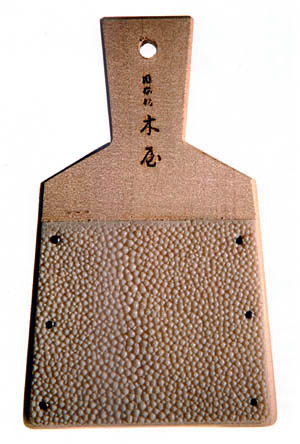
 This oroshigani (grater) is used almost exclusively to grate wasabi, the pungent yet sweet "horseradish" that complements sushi and other dishes. It consists simply of a piece of shark skin nailed to a natural wood board.
Shark skin has been used in Japan for centuries, most notably in sword grips, and here its rough texture - similar to the coarsest sandpaper - makes for a finer grating surface than metal graters provide.
Many chefs believe that metal is too harsh for grating wasabi; others say the extra pressure needed to grate on sharkskin does a better job of releasing wasabi's volatile flavor.


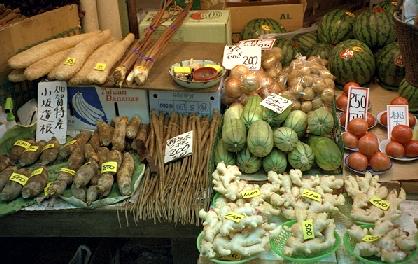
Ohmicho seafood  market, in Kanazawa, specialises in fish from the nearby Sea of Japan as well as local rivers. There are stalls of vegetables too and ..... in the summertime huge blocks of ice are set up in strategic locations and shoppers can cool off by rubbing their hands on them.
Read more : Tokyo Food Page


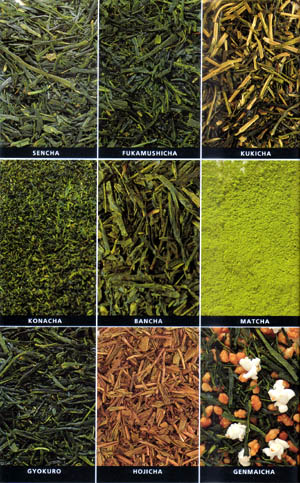
Tea is grown throughout Japan, but the areas that are most well known for their tea are Shizuoka, Kagoshima, and Uji, all of which have types of tea named after them. Many other locales also have their own distinctive local teas with their devoted enthusiasts.
From a book called:
 New Tastes in Green Tea
by Mutsuko Tokunaga


I absolutely loved Japan and the Japanese people, who took me in and showed me such kindness in my travels. It was very unusual in those days for a foreigner to speak Japanese and many people I met had never even seen a non-Japanese person before, except on TV!!   The beauty of and care taken with Japanese public and private gardens is immense and a part of the Japanese psyche and the Shinto religion, which worships nature, ancestors and the spirit. This respect and reverence for nature, whether in the wild or in the home garden, shone through every Japanese person I met. It gives enormous tranquility to life and drew me again and again to various shrines and gardens.
There is a beautiful series of photos at Tom Spencer's The Soul of the Garden and his Images of Japan

Saturday, 12 December 2009

HAPPY FIRST BIRTHDAY TO HUGH'S GARDEN!

 Hugh's patch


It was the first birthday of Hugh's vegetable garden this November! Back in 2008 we cleared away years of rubbish and neglect from the yard of the house he rents. And then we dug out some of the acres of concrete.... a shocker of a back yard to start with!

image

The soil is very sandy and in places it is just white sand, being so close to the beach. We dug in bags of compost from SA Composters, a brick of coconut fibre to hold the moisture in and Rapid Riser as the "soil" seemed so lacking in anything at all.


image


He started off wanting neat rows and vegetables grouped nicely.... and didn't like my approach of inviting nature in to work for you by having things all mixed up.

Everything grew like mad and he was so proud of it all.


Then the earwigs and caterpillars discovered it. He made earwig traps and sprayed Dipel for the caterpillars but thought there must be a better way. He bought a couple of books and studied them well.... Jackie French's "Towards Backyard self-sufficiency" and Lolo Houbein's "One Magic Square". Jacky lives in NSW and Lolo in Adelaide so he did well. Funny he chose these 2 books of the hundreds available at book shops because, unbeknown to Hugh, this Jackie French book was also my first vegetable gardening book a trillion years ago and I had recently met Lolo at Fern Ave Community Garden and thought her book looked great! 

Anyway, the gist of all this was that he began to plant herbs amongst the rows of vegetables. He gradually moved away from rows and went for ....dare I say it.... Mum's more natural approach!

imageimageDuring the year I helped him expand the garden into more of that concrete jungle but the things he grows and what goes where are all up to him.... I am just the worker following instructions these days.... something I am pretty shocking at!


......until now it looks like this! It brings a tear to my eye to see such a wonderful patch of paradise grow from such a harsh beginning and it just goes to show what you can do....


image


So, we sat outside in the garden and raised a glass to Hugh's first year as a vegetable gardener.

May the future bring him happiness and may his garden flourish.

image

See more photos of Hugh's garden here.

....I have no idea why I am having such trouble getting this to post how it is supposed to look. Has Live Writer gone mad or is it me??

Sunday, 13 September 2009

Nourishing our Bodies

Nourishing our Bodies - Food Matters -You are what you eat.

This week we have eaten out 3 times with friends, some things I ate were not too bad but mostly what I ate did not taste like food at all.

I need to get back in the kitchen and make some nourishing soups, casseroles and salads.

When we cook we add handfuls of fresh herbs from our garden, we buy organic flavourful meat and eggs.

We cook with spices and good oils, we add fresh veggies from the garden.

Our meals are full of colour, flavour and nutrition.

We always eat heaps of salad from the garden because we love the flavour of bitter, sweet, spicy greens and the fresh enzymes these fresh veggies add to our diet.

We want to grow everything, I want to process and save everything.

We will know doubt have a hot summer ahead of us.

How much food do we really need?

Can we save some water and energy by just making do with seasonal produce or is freezing excess food a viable option?

Can we maintain good nutrition from our herbs, sprouted seeds and tougher veggie plants?

We can probably maintain good nutrition with far less food than we normally consume.

So to move away from the thought of chemical filled processed food, I have made a collage of our Spring Garden to share with you.

It is a beautiful SPRING Sunday in Adelaide today, Happy Gardening.

Collages1

Wednesday, 3 June 2009

REAL FOOD.... REAL FAST

image


Why wouldn't you grow food when you can pick this for dinner on a cold winter's evening? As I wandered around the garden with my basket and knife, after the rain had washed all the vegetables for me, I was thinking of all the things I could do to make these vegetables into meals for the next few days....


image

  • "spinach" and fetta pie.... I use any leaves not just spinach
  • sorrel soup
  • dip the capsicums into lima bean puree
  • stir fry
  • salads of baby fennel bulb thinnings and flowers,  capsicums, sorrel, mizuna
  • my favouite Turkish "spinach"  soup
  • leftovers on toast for breakfast


Can you believe the colour of the stems of that red chard? image

And the chicory has gone nearly black  and oh so shiny.... I just love those cornos capsicums which are as sweet and as crisp as apples.... and the blue/green of the Russian kale contrasts superbly....

Don't you just want to eat it all? How lucky are we to have the chance to grow all this.... I cannot imagine buying food from the supermarket.... I have a funny story about that....

I visited my mother and we were talking about me visiting her next week on a different day. She likes to give me lunch when I come.

imageI said "Maybe I could come on Tuesday.... after you get home from the supermarket. That way you would have something for us to have for lunch."

She looked at me, with her jaw hanging open, and said " Don't be ridiculous! You can't get FOOD at the supermarket!"

We both realised what she has said.... both of us who grow food and buy the rest at markets.... and laughed and laughed....

I saw a stupid advertisement on TV last night... only one?, you ask!.... well this one was a sportswoman saying she wanted to give her children healthy snacks so she gives them such and such a fruit bar because "it contains a whole piece of fruit".... I said out loud to myself "Well then why not just give them the whole piece of fruit you crazy woman??" Honestly, how ridiculous but I do so love telling the radio and TV and various other appliances what I think of them....

So, who are all those people that think food comes from supermarkets? And would they feel as excited as I do if they too had all these vegetables growing in their back yards? Maybe not unless they were all packaged into things that claim to contain "a whole leaf of spinach" in every bite!

Tuesday, 2 June 2009

VERDALE OLIVE ESTATE AND CAFE

 image

The main road north from Adelaide takes you past Virginia, where much of the state's vegetables are grown and further on still, around the Two Wells area, are ever-increasing numbers of olive groves. So it was with great delight that I saw advertised in the Rare Fruit Society newsletter, a field trip to one of the oldest of these olive groves. Nick and his family, originally from Cyprus and Greece, have been running Verdale Olive Estate since the 1970's; 20 acres and 1500 olive trees, producing about 30 tonnes of olives a year. Together with some other growers they grow 3 main varieties of olives, mostly for eating but also some oil. They are kalamata, manzanillo and liguria. I like the liguria or wild olives best, like those that grow wild on the hillsides around Adelaide.

My main interest was to see how they preserve the olives and if they use any horrid chemicals, there or in the growing of the trees. Why it is that I am always the one asking these curly questions to innocent people who have so generously given their time for free, worries me not in the least and I have some very pleasant things to report about Verdale and especially about Nick's own growing and processing methods.image

A few years ago Nick was having problems with salt in the soil on his farm and after a soil test, found his soil was in a bad state. He decided the only thing to do was to go organic and he is very pleased with the results, if not with the certification process, but that's another story. Nick himself prefaced his answers by saying he is on the whole not into organics and all that kind of stuff, so it is inspiring to think he has found a natural way forward through the maze of chemical solutions on offer.


image If, like me, you imagine a big enterprise like this being full of shiny stainless steel and people in white coats then, like me you would have been surprised and oh so happy to see hundreds of pickle barrels outside in yards here, there and everywhere, with the chooks scratching around them, and a pallet of ordinary salt ready to be used in the next batch. Of course there are shiny machines for pitting and sorting and so on but then out they go into the barrels in a solution of 3% salt for a month. And that is when the lacto-fermentation starts to take place....( like Claudia was telling us about.). See the white stuff in the photo below.....

 image Nick processes the olives from all the farms he sources the olives from and every barrel is labelled as such so the origins of every olive is known from start to finish. Nick was so generous and gave us cuttings and fruit from his favourite pomegranate trees, as well as directing us into his on-site cafe and giving us tastings of the olives, dips, oils and other condiments they make there. The coffee I must say was excellent, the pizzas made in the wood oven delicious and the olives were really tasty. Those of us who stayed to the end were lucky enough to receive some vegetables from the garden, some semi-dried olives and a flagon of oil which was from olives picked and pressed yesterday, at a very good price. You should see the colour and oh the aroma is heavenly!

The cafe is open Saturdays and Sundays from 10am to 4pm.

Verdale Olive Estate, 27 Bailey Road East, Two Wells. Although it is right near Pt. Wakefield Rd, you can't enter Bailey Road from there and must take another route.

image


Out the back Nick has this little pineapple growing.... aren't they the weirdest things, growing up on a spike like that? And he also had a piece of sugarcane growing too.

image

The dogs were gorgeous  and there were tiny puppies too...


Thanks so much Nick.