Showing posts with label Preserves. Show all posts

Thursday, 1 September 2011

World Kitchen Garden Day 2011 at Glandore Community Garden

Last Sunday we all gathered at the beautiful Glandore Community Garden for an enjoyable World Kitchen Garden Day afternoon.

When we arrived plot holders were busy working in their plots.

Harry was busy working on the wood fired pizza oven which will be is going to have a mosaic added soon.

Everyone chatted about what excess produce they had bought along as well as something they had cooked from their country of origin.

Produce to share included Lebanese cress, bunches of coriander, Jerusalem artichokes, lima bean seeds, plum jams, chilli jams, lemons, fennel, chillies and a lot of different potted up plants.

There were lots of seeds to share and a favourite seed we saved this year was chervil which is a lovely herb we are picking at the moment.

We had an apple amaranth cake from Argentina, Indian Spinach and onion fritters, Irish pumpkin dip, German lemon cake, Middle eastern Humus, French Cheese and Biscuits, German raspberry muffins, Spicy Orange Muffins and an Aussie multicultural creation of brightly coloured Nasturtium flowers filled with humus and topped with sweet chilli jam.

Daniel (from Gardening Australia fame) told us all about an Orchid show he had just entered in and his Mum said he was being very modest and had won 2nd prize in his Category.

Thank you everyone who came and shared their knowledge, kitchen garden food and kitchen garden produce with us.

We look forward to World Kitchen Garden Day 2011.

World Kitchen Garden Day 20111

Monday, 6 December 2010

From Seed to Table - a great blog to read

The Blog “From Seed to Table” has a most amazing summary of what Michelle has grown, harvested and processed this past summer in California.

What makes it even more interesting is that what she is harvesting is just about the same foods that we are planting now and hopefully will be harvesting in the near future.

I am certainly going to try several of her recipes including her November 30th post recipe for

Slow Roasted or is it Quick Dried Chile Peppers.

Please check out this blog for new ideas of how to preserve and use summer produce.

Congratulations Michelle and thankyou for such a great blog.


The photos below were taken last summer in our garden.

Many South Australia gardeners are still planting up peppers, eggplants and chillies.

Others here are harvesting zucchinis, lettuce, spinach, onions, radishes, rocket, basil, artichokes and the last of the broad beans.

Tomato bushes are flowering and some folks are already picking early tomatoes. Beans, cucumbers and figs are growing nicely. 

It is apricot, berry and cherry harvest time in South Australia and fresh platters of mixed berries are appearing on dinner tables.

Eating local, organic and seasonal food is exciting. There is always some favourite fruit or vegetable reappearing at the dinner table.

There is always the anticipation of different things to grow, harvest and preserve.


Xmas Garden1

Monday, 2 November 2009

Lemon rain…

The chooks that live under our lemon tree have it all figured out – as soon as they hear the rustling in the leaves overhead that signals another lemon bomb about to land in their midst, they scatter to the winds…

I wish I could scatter to the winds! Every day I go outside, another bucket load of lemons has fallen to the ground, awaiting our attention.

We use about one lemon per day in salads, but we get two crops per year with around 50 kg of lemons just off this one tree.

So, lemon recipes anyone? Ones without sugar? And yes, we do freeze the juice for the lean months, but it never tastes quite the same…

IMG_0025 We met a nice Chinese couple recently who’d never seen a lemon tree before. Lucky them!


So here’s a typical scene in the kitchen; lemon tyranny!

DSCN0010


On the plus side, Spring sunsets over the lemon tree are rather picturesque…

DSCN0002

Tuesday, 13 October 2009

Summer and Winter Garden Harvest Recipe Plan

Garden & Dandelion 011 Garden & Dandelion 015

This year I am going to start a folder with recipes I would like to try using produce from the garden or bought locally.

Nothing is more frustrating than having a table full of produce that you want to eat raw, cook or preserve and not have recipes and ingredients ready, so you can get cooking straight away.

I usually head for the computer do a Goggle search and end up with all sorts of ideas and no time or energy left to do anything.

So this year the Google searches will be done in advance and the recipes will be clearly arranged with the spices, vinegars or honey and empty jars already in the cupboard. There will be a plan!

Last year Cath had given me her peach chutney recipe which I adapted as different fruits appeared in the kitchen.

There are some great gardening, cooking, preserving bloggers around the globe who have great recipe blogs.

One of my favourite cooks is Laura from Mas Du Diable Cevenol Kitchen who has loads of great recipes including an Indian section with all sorts of pickles, chutney’s and preserves.

Tamra from Eat Seasonally has some great seasonal recipes as part of her gardening blog. As soon as the purslane appears in the garden I am going to make her “weed Tacos”. Read the story that goes with the recipe about her teenagers’ text messaging their friends when told they are having weed tacos for dinner.

Olives and artichokes have a wonderful Mediterranean recipe section as part of their blog. It show wonderful ideas for what they do with daily produce from their garden.

There are many different groups that form part of Kitchen Gardens International. My favourite groups are the Pickling and Preserving, the Harvest group and the Kimchi group. I have enjoyed reading the members pickling and harvest adventures through out our winter. Gillian a KGI friend from Queensland posted a great tomato & chilli sauce recipe, I have bottles already for that recipe.

Please join KGI and share your ideas and gardening experiences with people from all over the world.

Because we have a small garden we tend to harvest everything and then prepare the soil for our next batch of seedlings.

This week we pulled up all the celeriac and fennel.

When trimmed back the celeriac was roasted and some sliced and eaten raw. The tops went in the compost. We may not grow celeriac again, it was in the ground for a long time, I think the leaves may have been trimmed back more. We had huge leaves and smallish bulbs. Have you grown celeriac, is there a secret?

I remembered a recipe on our Recipes Gardeners Gastronomy section, which Kate recommended and which I cooked last year. It is absolutely delicious. Fennel bulbs and beetroot chunks are roasted, covered with olive oil and balsamic vinegar. It is quick and delicious, lovely eaten hot and even better kept in the fridge and eaten as a salad.

Organic gardening is fun, watching seeds germinate and grow is exciting, planting and then harvesting veggies is a great experience, cooking and eating those delicious veggies is a heavenly experience. I hope your new seasons veggie patch is exciting and delicious.
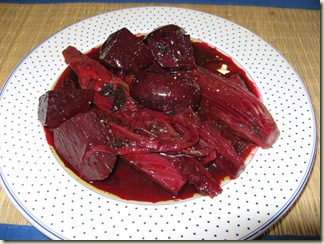

Beetroot and Henley 004 Garden 033

Monday, 7 September 2009

Making sauerkraut

The Roman emperor Tiberius always carried a barrel of sauerkraut (lacto-fermented cabbage) with him during his long voyages to the Middle East because the Romans knew that the lactic acid it contained protected them from intestinal infections. In ancient Rome, sauerkraut had a reputation as a food that was easy to digest. In China, they fermented cabbage 6000 year ago… [from the book ‘Nourishing Traditions’ by Sally Fallon, page 92..93]. Sauerkraut is also an excellent source of Vitamin C, and so was carried on board sailing ships once the link between the disease ‘scurvy’ and lack of Vitamin C was established as the cause of teeth-loss and declining health of sailors on long sea voyages.

Somewhat more recently, my wife’s relatives in Germany stored cabbage for the long cold winter months by making sauerkraut and storing it in the cellars beneath their homes in the village. The particular large conical cabbages they use are unknown here in South Australia, but are commonly available from gardening shops in Germany, from whence my small store of seed came.

These cabbages grow to over a metre in diameter, and the cabbage head can weigh many kilograms. If left too long in the garden, they also fill up with slugs and earwigs or bolt to seed as Spring brings warmth to the soil.

DSCN0005Making sauerkraut is labour-intensive, as the cabbage must be cored, washed, shredded, mixed with whey, sea-salt and caraway seeds then pounded with a wooden pounder to release the juices. It is then pressed tightly into wide-mouthed jars with the wooden pounder until within 25 mm of the top of the jar then covered tightly and kept at room-temperature for three days. It may be eaten immediately but improves with age.

DSCN0009 DSCN0011

We don’t have a cellar to keep things cool, but we did pay a chap $200 to cut a trap-door into the floor space on the cooler southern side of the house through our wooden floor; we keep the finished sauerkraut down there between the foundation piers.(Also stored down there are rice, sultanas, grains, olives and other lacto-fermented vegetables and meats that we are still experimenting with…)

It’s also a handy spot to store very large cooking pots that don’t fit into the kitchen cupboards.

DSCN0012 DSCN0014

Tuesday, 15 July 2008

A RAINY DAY IN THE KITCHEN

Well, not actually raining in the kitchen, although it did once, a few years ago!


I decided the olives were ready to put into jars with a mixture of oil, vinegar, water and a bit of salt, after about 2 weeks of soaking in water (which I changed every day)


I made the syrup and strained the limoncello into a vodka bottle.
It will be ready in a couple of weeks.


I made a cake to share with a hugly bear!


Thursday, 21 February 2008

Taking Tea in the Medina

This would have to be one of the most beautiful cookbooks ever!

taking tea in the medina by Julie Le Clerc and photographs by John Bougen & Jule Le Clere.
You must check it out at your local bookstore or library.

The recipes are well set out (one per page), they are easy to prepare and do not contain too many ingredients.
They also have large photos of what the prepared dish will look like.
And heaps of the ingredients will be growing in your garden at the moment.

Ok, so I shall mention a few recipes to tempt you:
courgettes with mint, okra in tomato sauce, pickled tomatoes with spices and red wine vinegar, Kuku- a parsley omelette, red pepper and walnut paste, smoky eggplant puree with garlic and mint, zhoug-a hot coriander and chilli relish, kutap-flatbread with herbs or pumpkin, carrot or watermelon jam and maybe some chocolate dipped figs and dates on crystallized rose petals or some baklava with cardamom.

Well! its time for me to grab a handful of fresh mint from the garden, make some mint tea and then maybe make an Um Ali - a classic pudding with pistachio nuts, raisins, milk, honey, cinnamon and whipped cream.

Tuesday, 29 January 2008

Relishes or chutneys


I have been given a few kilograms of tart small blood plums. I have cooked some just to have for breakfast, I shall save some to eat fresh.
One year I made plum sauce but you usually do not eat much plum sauce.
So I am thinking plum chutney, something to serve with cheese and crackers or something to serve with a curry or to give as gifts.
So I invite you to post any good chutney recipes you have .
I have lots of leeks and chillies and I always adapt recipes adding my favorite spices but I would like a chutney recipe with good shelf life.
The photo above comes from a site called Musings from a Stonehead. Click on Musings from a Stonehead to view the site.