Showing posts with label Food for Thought. Show all posts

Sunday, 28 February 2010

INDIA BANS GE EGGPLANT - MONSANTO 'FAKES' SAFETY DATA

The Indian Government has banned genetically engineered (GE) eggplant after the ex-Director of Monsanto India admitted the corporation provided 'fake scientific data' to regulators. In announcing the moratorium on GE eggplant, Indian Environment Minister Jairam Ramesh, said there was not enough evidence that GE foods were safe to eat and that they didn't harm the environment.

Do we need any more proof than this that Monsanto is up to no good? Those who think GE foods will save the world should be shot. There is no such thing as a free lunch.... we cannot bypass nature in the quest for profits. Congratulations India! In many ways the Indian government is far ahead of ours. Kevin Rudd should get off his high horse and take a look outside, in the real world.

Saturday, 27 February 2010

THE ANSWER TO THAT QUESTION.... HOW TO FEED THE WORLD

There you have it.... and it was obvious all along but I just couldn't put my finger on the link.... I must be getting old....or something!

Monoculture means growing one thing, usually on a massive scale and killing everything that dares interfere with that one thing, with chemicals.

Then there was organic but often it came to mean growing one thing, on a massive scale and killing everything that interferes with it, with chemicals made from natural substances.

In the organic vegetable garden I always encourage people to make use of every little microclimate, interplanting tall things with short to get shade in the heat of summer; always having flowers and seedlings and mature plants in the same bed; feeding the soil and the plants will feed themselves..... but still I was not quite sure what to say when asked "How can we feed the world this way?"

But then there was "Fresh" the movie.... and I have the answer... its all about food being nutritious and the loop....

Monoculture is like a huge field of wheat; when the crop is taken, there is nothing left. The farmer must get the land ready for next year by fertilising, spraying for pest and weeds, fixing machinery and buying seed. He spends many thousands of dollars on inputs from all over the world, which are trucked and shipped and give me a headache thinking about. Lets say that after expenses, he makes $100 / acre for his wheat crop if it is a good crop and if prices are good.

Then lets look at the kind of farmer shown in "Fresh" who has several fields of mixed grasses which soon self seed every year. First he puts cows on the field. Cows eat grass and grow big. Every few days he moves the cows to the next field, then the next and so on around the property. As the cows go along they fertilise the grasses but they also attract flies which lay their eggs in the dung, and flies carry diseases which can quickly spread through the cows when they come back to this pasture. Eventually he sells the cows for meat, to a local butcher. It is organic and of excellent quality and he might get $100 / acre. His cows had calves and so his next generation is produced.

Second,  3 days after the cows are taken off he lets in the chickens to the first field. The fly and other insect eggs have hatched and the chickens are in rapturous delight and gorge themselves, laying big, healthy, nutritious eggs for the farmer to sell. From these large, organic eggs the farmer receives $100 / acre from the local organic food shop or from the farm gate. Some of the eggs are allowed to hatch and become the next generation.

Third, in come a host of meat birds that eat a different selection of grasses to the cows and the chickens. Once these birds such as geese and turkeys have been through all the fields, they are sold for meat. They are healthy and strong and organic and he might get $100 / acre, sold direct to local shops. These also reproduce themselves.

Fourth, the grass is now well fertilised by cows, chickens and other birds and grows fast. The cows are allowed back in again before the grass dries and goes to seed. Now the farmer cuts it for hay. He uses some for the bedding and winter feed for his animals and sells the rest. He might receive $100 / acre from local people direct from the farm. The grasses self-seed and come up again next spring.

Moreover, some of the fields of the sustainable farmer produce a variety of vegetables at various times and some may have fruit trees under which the chickens graze in their rotation. The system is flexible and is a closed loop, with few inputs from beyond the farm. All his produce is sold locally.

Even with this simplistic view, you can see that he is producing many times the volume of more nutritious food for human consumption than the wheat farmer, whose crop is shipped around the world where it is processed and made into white flour which ends up as items wrapped in plastic bags in supermarkets thousands of kilometres away, adding little but carbohydrate to the diet to those that eat it. And it seems, from the documentary, that the multi-cultural farmer reaps the rewards financially too.

The multi-cultural farmer needs workers to help. He creates employment for locals. Those who may otherwise be driving trucks or ships of wheat, stay home and work on this farm and themselves learn the value of nutrition, raising healthy children who take their message to school and help start a school vegetable garden..... and so the effects go on and on, rippling through every avenue of society.

In this way we not only feed the world but it is sustainable, reducing greenhouse gases, climate change, pollution, medical expenses, unemployment  etc etc etc and generally making the world a happier place for everyone.

Watch a trailer, join the movement, find a screening here. It is American, and I am always sceptical of American things (sorry Pattie!) but this is genuinely good and farmer whatsit who lets his chickens be chickens and develop their chicken-ness is fabulous..... as is the big, ex-basketballer turned urban farmer.

Thursday, 25 February 2010

THE TROUBLE WITH ITALIAN FOOD....


"The trouble with eating Italian food is that

five or six days later you’re hungry again."

~ George Miller

There are more and more blogs in Italy and some about Italian food. This quote and photo came from Aglio, Olio & Peperoncini and some ideas for polenta that make me go straight to the cupboard to start cooking lunch, before it is even 8am!

My favourite blog in Italy is Path to Self Sufficiency.... obviously not by an Italian but here is a lovely snippet from a recent post by Heiko ( a Dutchman, who was brought up in Germany and has lived in the UK for a long time and who now lives in Italy on the border between Liguria and Tuscany):


.......To put it quite simply, I really do not understand the concept of money. I mean it, I don't. I can just about follow why they invented it in the first place. Back in the days when humans just roamed the countryside, life maybe wasn't exactly easy, but it was simple. All you needed to sort out was who went foraging for berries and roots and who did the hunting. In the evening they all met up again and shared their spoils.

When they invented culture you could still manage quite easily. You hunted an extra wild boar or deer, picked a few more berries and invited the guy with the interesting metal contraption from the other valley to bring along some pina colada and the other chap who manages to extract those strange sounds out of an old goat skin to join your feast and hey, you had a party!
But once people started settling down people started to specialise. There was the cabbage farmer, the goat herder, the medicine man, the carpenter and the plumber. Once the cabbage farmer got himself yet another acre of land he needed a bit of help. But soon his workmen got bored being paid in cabbages, there's only so much you can do with them. So they needed to come up with some sort of currency, some sort of token with a value they all agreed on.....
read on...

It gets better and better and is a great little story!

Wednesday, 24 February 2010

HUGH'S PATCH.... YOU WON'T BELIEVE IT NOW!

If you have been following the story of my son Hugh's garden, you will know that he started with a yard FULL to the brim with concrete about 18 months ago. I got the phone call to please come and help start a garden one morning and was told to bring wheelbarrow,tools and compost! Of course I was keen to see him start to grow vegetables so of course I obliged and by the end of the day he had a little area about the size of 2 dining room tables to plant into. For some months I received frequent phone calls from an excited Hugh telling me his first tomato was ripe or his lettuce was being eaten by goblins at night or asking was it the right time of the year to plant beetroot or bananas! Every evening after work he would sit out beside his patch while having a beer and gaze in wonder, like a father with a baby. It was not a big enough area for two people to sit next to easily, and one day I had another phone call. When I arrived, this first photo shows what we had to tackle to make a second bed. This is the story of the evolution of this bed....

image 


April 2009.... oh hell !! It was a rough delivery for the second baby but sand is, at least, easy to dig!
image
Leaves flourished and Hugh was proud... 
image
image
February 2010...a new plan hatches one fine summer's morning... construct an edible water garden, with style...


image


This very morning we finished it and I must say it is a wonder to behold and a delight to sit beside and music to my ears to hear the tinkle of water trickling off the rocks into a pond planted with watercress I originally received from Deb and water chestnuts originally from Cath.

The edges will be filled with lettuces and herbs and you can see a few young amaranth on the left which will give shade in the late afternoon when they grow. There are some tubers of cardamon behind the rocks, and although they don't flower here, the leaves can be used to wrap fish or vegetables, for a fragrance like lemony cinnamon.

The water is still murky as we had only just retrieved one of the large rocks that toppled into the pond while we were adjusting the water pipe!

It certainly goes to show that gardening is all about observation, inspiration and determination!

Wednesday, 17 February 2010

HUGH'S LITTLE PATCH OF THE MEDITERRANEAN

  imageBy now our summer vegetables are all established and should be producing well but with another heatwave looming down on us, it is hard to stay positive about gardening in summer, in South Australia. I think a covering of the white 50% shade cloth is the answer to keeping leaves and other soft vegetables going well. To a human the white does not seem to provide a sense of shade but to the plants it is the perfect solution as they need to keep photosynthesising to survive and only the white shade cloth allows the full range of sunlight through, but cuts the intensity by 50%. In my little shade house made of this fabric, lettuce and other leaves flourish and nothing is as uplifting as walking in and seeing such happy plants, even though temperatures may be in the 40's. Have a look at Scarecrow's garden for ideas on how to erect the white shade cloth.

image At Hugh's he has developed a different approach, as we have had the time to toss ideas about together and time for him to learn little by little by direct experience. Living in a rented house with a yard completely covered in concrete has made him learn to be creative and to adapt to what is cheap, easy and possible. For example, he has lettuce and other leaves growing under the tall amaranthus, making a perfect microclimate. After the accidental success of the bok choy planted around the bird bath, Hugh has put a large pot of water amongst the amaranthus to raise the humidity and on hot days this certainly seems to work, as amaranthus in other places tend to get burnt edges on the leaves. It is amazing how fast this water evaporates in our searingly dry heat.

The floor of the tomato bed is covered in herbs such as the Laksa herb, garlic chives, various basils and tarragon. The capsicums are planted so as to be shaded in the late afternoon only; galangal, beetroot and beans receive afternoon shade from the neighbour's gum tree while sweet potatoes and purslane creep between the eggplants. There is no shade cloth,other than the little shade house only careful planning and, despite the abominable mass of concrete, the garden is flourishing like an oasis.

imageOf course there have been casualties! The biggest problem that is very hard to alleviate is the wind which rips through everything, bouncing off fences and rattling even the seemingly most protected areas of the yard. Luckily tomatoes love wind and it keeps away diseases but a week of dead calm has seen the arrival of some mites..... now we are hoping again for the wind to return! Whether it was the wind or something in the soil we don't know but the corn was a disaster, after starting strong and magnificent and everything planted in that bed has failed to thrive..... cucumbers, beans, even zucchinis. But the idea was good.... the tall corn was to protect the cucumbers and the beans were to climb up the corn and everything was supposed to be one big happyimage family!

Before Hugh became interested in growing fruit and vegetables, a lovely old apricot tree died of neglect. Hugh has sown his tallest beans around the dead tree and this is fast becoming a bean tree. Underneath are also marigolds and echinacea and there is a single comfrey plant establishing itself and hopefully soon it will form a clump from which Hugh can harvest the nutrients said to be inside those magical leaves.

There is a dreadful little walled section of garden just wide enough to cook the soil in summer so into it we planted native sand dune plants from this area as well as some okra which loves extreme heat and dry soil. At one end some established spring oniony things are doing fabulously too.

image

The water from the rain water tank is used to water those things that suffer most from our salty mains water..... tubs of fruit trees and the salad garden, purposely planted right next to the tank because neither of us believe we should be using pumps... that is something I have written about before and no doubt will again. In the '50's when this house was built, people did sensible things like putting the tank up on a stand to give some head or pressure; today this seems to be all forgotten and people use pumps and make pollution in order to save water !!! To make most use of the vertical space and to keep the tank water cool, Hugh has just planted 3 different passionfruit in tubs, after covering the tank in chicken wire for them to climb up..... what terrible English this is but I am running out of time and need to get ready to go to Wednesday gardening at Sally's!!

Everything is thought through here and lessons learned, as best we can, for next year. It is amazing what you can do, no matter what your constraints. All you need is observation, imagination and ..... oh, please find the word that eludes me to go here..... it means effort/to bother/.....oh yes... determination! These 3, as my old school passage from the bible goes, but the greatest of these is observation !

Friday, 12 February 2010

Comfrey and watercress and a cancer theory

HERBS ARE SPECIAL......


There is a lovely Australian website and blog for lovers of all things herbal. It is Isabell Shipard's Herbs Are Special. It explores every herb I have ever heard of and lots more, in depth, and son Hugh sent me a link to the page about comfrey, which has from time to time been given a rough trot. Maybe, like many another theory, comfrey is about to have its name cleared and become the latest wonder herb, as it once was. Being a lover of leaves and knowing how easy it is to grow comfrey I would love to start eating it too....well, actually I put it in last night's dinner. I know chooks love it and I have fed it to mine for years. It would be interesting to know what readers think.

....Read the book, ‘World without cancer, the story of vitamin B17’ by Edward Griffin, which reveals how science has been subverted to protect entrenched commercial and political interests. The book explores the revolutionary concept that cancer is a deficiency disease, the substance missing being B17 (also called laetrile), discovered by German chemist Leibig in1830, and further researched by Dr. Ernst Krebs and others.

Another Australian, who valued the HDRA research, was Foster Savage, who I mentioned earlier. I had the opportunity to know him, personally, when he settled in Nambour to farm (and later Cooroy); and, I knew you would guess, he grew lots of comfrey! Wilted comfrey was fed to his animals in large amounts. Why did he allow it to wilt? He told me that animals could eat much more, each day, when it was wilted! He often had groups and private people visit and he would, freely, share his knowledge of comfrey and how it benefited his land, animals and his family (note, he had 13 children). When legislation placed comfrey on the poisons schedule in Australia, and newspapers highlighted the ban, he wrote a letter to the Sunshine Coast Daily, in defense of comfrey, saying:

"I was perhaps responsible for 95% of the comfrey in Australia, having introduced the plant to this country in 1954, and having used the plant in great quantities, since then; I am, perhaps, competent to speak about it and to make a few comments on the …remarks about comfrey made by the CSIRO scientist …"To say that two leaves, eaten daily - over a couple of years - will cause serious disease, is simply not true. In our house, we have eaten 70 leaves, or thereabouts, daily, for 24 years: in the form of comfrey tea, liquidised in a vitamiser as a green drink, and in salads. I also fed comfrey to my farm animals.

Knowing the power of comfrey to restore a worn out animal quickly, and make her milk again, I once bought an old cow at the Dandenong Market, when farming in Victoria. It had been discarded by some farmer, as worn out. I put her on comfrey, giving her 90 lbs of wilted comfrey (wilted to increase the cow’s intake of comfrey’s extraordinary nutrients), and 90 lbs made a pretty big heap, about 4 feet high. This poor, old, creature took to the comfrey, without hesitation … she was starving for minerals and her instincts gave her a craving for comfrey. When she began to eat, she would eat off the heap of leaves for a couple of hours, then sit down for an hour or so. Later, she would continue eating, until every leaf was gone. If Dr. Culvenor’s words were true, imagine the poison she would be taking into her body, with this quantity of comfrey daily. If comfrey attacked the liver, then this cow would have died, because she was in a worn out condition. Instead, she doubled her milk output, within a week, and in a fortnight, trebled it. The remarkable thing, was that the cream that settled overnight, was some 3/4 inch thick and the separation of cream from the milk was so perfect, that the cream could be lifted off, with none remaining. I fed comfrey to calves, as much as they could eat, again with only gratifying results. I fed pigs, entirely on comfrey and grain, as much comfrey as they could eat, and the quality of those pigs was legendary, in the district.

The fame of comfrey spread far and wide, for my farm was visited by 6,000 farmers from around Australia and from overseas. Finally, I well remember the enthusiastic remarks of the butcher who regularly killed our comfrey-fed calves. He told us that he had never before, seen such healthy livers … that, mind you, after being reared on a herb that was supposed to cause liver diseases!"

 Watercress is one of my favourite salad additions and the information on this website about its properties makes me glad it is also very easy to grow in a tub of water. You can give it a haircut daily and it seems to grow back overnight in summer!

You can buy herbs, vegetables and fruit trees and seeds from them too....http://herbs-to-use.com/herbs-for-sale/trees-fruits-vegetables-legumes-rare-edibles.html. I will put their link in the side bar, under seed companies.

Picking Herbs To UseYou can visit the Shipard's Herb Farm, which is in Queensland:

139 Windsor Rd., Nambour.
(on right, past Sunshine Coast Institute of TAFE)

Open hours -
Monday, Tuesday, Thursday and Saturday - from 10:00am till 2:00pm.

If you would like to come at any other time, please phone during open hours a day or more in advance to confirm a time when you would like to visit.

Phone No. -
(07) 5441 1101

Fax No. -
(07) 5471 6430

email -
info@herbs-to-use.com

There are no blog entries after 2008..... shame... but you can subscribe to email updates from Isabell.

Thursday, 11 February 2010

ORGANICS AND BIODIVERSITY IN AUTRALIAN FARMING

Patrick of Bifurcated Carrots often writes of the lack of meaning for the word organic in Europe these days, as regulations are loose and agribusiness continues to rely on monoculture. Here in Australia things are, thankfully, quite a bit different and I think we can be reasonably confident that biodiversity is an integral part of organic certification. Here is an excerpt of the latest edition of the Biological Farmers of Australia free online newsletter:

Biodiversity and biological farming; a natural partnership

.............Major independent studies have confirmed organic farming actively contributes to better levels of biodiversity at every level of the food chain than non-organic systems. Organic agriculture is proving that we not only must, but can, have our environmental cake and eat it too.

A major pillar of organic production, and the vanguard of biodiversity protection, is maintaining a rich diversity of plant and animal life as the basis for the health of crops, farmed animals, the environment and the community, which are all inextricably linked.

Under the Organic Standard, management decisions must take into account impact on native flora and fauna and hydrological considerations, embracing protection of shelter belts, corridors, wetlands and remnant vegetation protection.

All forms of environmental pollution – chemical, genetic and physical – must be minimised and non-renewable resources must be conserved.

Rob Bauer, a fourth - generation farmer on his Queensland property in the Lockyer Valley, inherited land that the original European settlers had been obliged to clear – and keep clear of regrowth – by government dictates.

Rob converted the property to organic farmland thirty years ago and since then he has seen a marked change in the diversity and populations of native animals and vegetation on his land.

Repair of much of the existing environmental damage was assisted by an ongoing co-operative venture between Rob and Landcare which began in 1985. On a demonstration block in a previously degraded area more than two hundred rare, endangered and “interesting” native trees were planted. Rob carried the concept through the whole farm, which now has, interspersed with the cultivated fields, flourishing native bushland which is home to innumerable native animals, birds and insects, as well as providing shade, shelter and fodder for farmed animals.....

I also thought this comparison was interesting:

Australian organic avoids elitist attitude

A slow in the growth of organic sales in the UK has prompted prominent organic certifier and charity organisation, the Soil Association, to voice concerns consumers now see organic as a high-brow and expensive alternative.

.........However, an organic choice for many Australian organic consumers is not only about money - it’s about understanding and appreciating inherent value. Organic food represents environmentally-friendly food production, without synthetic chemicals or genetically modified ingredients, a focus on animal welfare,  etc and those are values more people are taking an interest in and willing to support, regardless of their socio-economic status..........

Read more of these articles by subscribing to the monthly Organic Advantage E-zine.

Friday, 5 February 2010

WHY SHOULD WE SAVE SEEDS?

As we all know, different parts of the world have different plants, animals, weather, soil and water conditions. For millions of years creatures of the earth developed characteristics that best adapted them to these conditions. Those that did not have the genes to adapt to the slow but constant heating and cooling of the planet died out; those that could survive the changes went on to flourish. Humans began to collect the seeds of those flourishing plants and sowed them closer to home, allowing them to stay in one place and so gradually the nomadic lifestyle died out in many parts of the world, starting about 10,000 years ago. They also herded animals together, built barriers to keep them in and so began rudimentary farming.

Every season the peoples of the mountains and valleys and plains of the Middle East, Africa and Asia sowed their seeds, grew their food and saved some of the resulting seeds for next year. Travellers in ships, on camels and on foot started to swap their seeds and produce and so to introduce new vegetables and fruits to each other. The people in the new lands would try to grow the new crops and sometimes succeeded, sometimes not but always they saved their own seeds from year to year and in this way the new crops adapted to the new lands and so, over the centuries, different varieties became suited to very different conditions. This is called conserving the processes of evolution and adaptation.

These days seeds are sold in packets in supermarkets, garden centres, hardware shops and nurseries. Mostly we have no idea where they come from. In South Australia, for example, there are no seed companies growing seeds suitable for our climate. Every year lots of people buy the same seed, and do not save the seed from their previous crops. As the climate changes, our seeds are therefore not adapting because they come from somewhere else. Soon we begin to find that fewer and fewer seeds are working for us in our gardens because they simply are not suited to our climate. People try adapting to the seeds by covering everything with shadecloth or using more water or adding things to the soil or spraying for pests which like to eat the sick plants. We have stopped conserving the processes of evolution and adaptation.

People who save seeds are saving the genes of adaptation and allowing evolution to continue so that no matter what happens to our climate, our seeds will have adapted year by year to those changes. There is a lot of fear about climate change and food security but all we need to do is allow our seeds to adapt season by season; always saving the seed from the best plants to sow next year. Buying seed from seed companies far from your home will not work, as our climate changes faster, and artificially genetically modifying the seeds is a pointless task and only seeks to make money for seed companies, destroying the processes of evolution and adaptation forever, leading ultimately to the destruction of our food chain.

So that is why we must save seeds. If you don't feel competent to do it alone, join a local seedsavers group where others can help you get started. You can find one here in Australia, but there are people saving seeds in every corner of the world. In our Hills and Plains Seedsavers group, we swap seeds between ourselves and give them away to friends. This way you don't have to save all your own seeds, just a few to share and soon you will find you have lots of different seeds to try and that these seeds will be adapted to your growing conditions.

Please read more about agricultural ecosystems here.

Wednesday, 3 February 2010

SINK AND WALL GARDENS

A lot of vegetable gardening authorities, whatever that means, suggest planting vegetables on raised beds but in South Australia and a lot of other Mediterranean zones, this, to me is madness. In places where summer water is oh so precious, we do not need to provide drainage, we need to be preserving every drop of water for the plants. If you look at raised garden beds, you often find the paths, which are lower than the beds, grow lush crops of weeds and grasses!

Jude Fanton has found these beautiful gardens in the arid zone of western Rajasthan, India, which show what can be achieved when we look at our own environments and not those of people on gardening shows in other climates, even in the same country as ourselves.

I don't know if you remember my terracotta pots idea, but it comes from looking at my own situation and works wonderfully well in doing several things to help plants get through our extreme summer heat.

First, unsealed, unglazed terracotta is simply fired clay and is porous so the water moves very slowly out through the pot into the soil, keeping plants such as lettuce and bush beans turgid and fresh even in the full sun on days over 40C.

Secondly and probably equally as important, the water in the clay pot, covered with a tile, keeps the surrounding soil temperature from rising too high. It is high soil temperatures which damages the roots of plants and causes them to burn off, in extreme heat, and stop the roots sucking up water even if it is available.

For more on this experiment see these updates:

 http://hillsandplainsseedsavers.blogspot.com/2008/02/do-you-know-what-didnt-droop-today.html

Kate and the Beanstalk

Using tank water without a pump

Olives and Artichokes

Recently I experimented with another similar idea, where I put an open, plastic bowl full of water in the middle of a large, shallow tyre-pot and surrounded it with tiny, caterpillar-eaten bok choy seedlings. I could not believe the speed of their growth compared to seedlings I planted elsewhere and they were ready to eat in 21 days! I am not sure why it worked, maybe the water heated during the day and kept the soil temperature warmer over night..... maybe it was the humidity provided by the water..... maybe both.

Thursday, 28 January 2010

THIS YEAR "EAT, THINK AND BE MERRY"

Why you should avoid eating anything raised in a monoculture.... animal or vegetable

This link was sent to me by Jan Maes, KGI Board Member

Jamie Harvie, PE, is executive director of the Institute for a Sustainable Future, a Duluth, Minnesota,-based not-for-profit research and consulting organization. He is a nationally recognized mercury-reduction expert who provides consulting on toxics reduction both nationally and internationally. His clients included the Minnesota Pollution Control Agency, City and County of San Francisco, and the Chinese Environmental Protection Agency.

......Animal feedlot operations may be considered industrialized protein production
facilities. They epitomize the extreme of our industrialized food system. These operations confine large quantities of livestock to a closed area where all food and water inputs are carefully controlled.

A wide variety of feed additives are provided, including growth hormones,antibiotics in feed and water, and arsenic. Arsenic, though banned in European livestock production, is used domestically as a growth promoter to compensate for poor growing conditions and for pigmentation.

According to the US Environmental Protection Agency (EPA), approximately 70 percent of the 8.7 billion broiler chickens produced annually are fed arsenic (Wallinga 2006a). In a recent study, 55 percent of raw, supermarket chicken contained detectable arsenic, and nearly 75 percent of breasts, thighs, and livers from conventional producers carried detectable arsenic (Wallinga 2006a). Arsenic causes cancer and contributes to other diseases, including heart disease, diabetes, and decreased intellectual function. Even low exposures to this type of serious toxin are generally presumed to be risky (Wallinga, 2006b).

In many areas of the US, groundwater used for drinking water may be naturally high in arsenic. The application of arsenic-laden manure further contributes to this drinking-water concern (Christen 2006).

Since 1972, there has been a tripling of counties that have more that 55 percent of their plantings in corn and soybeans (Porter, Russelle, and Finley 2000). Corn and soybeans are two of the most overproduced crops. Twenty-five percent of all US farmland—80 million acres—now grows corn (Christensen 2002).

...Petroleum-derived nitrogen and other fertilizers must be added to soils. Poor nitrogen retention by corn and soy rotation results in contaminated surface waters that migrate to the Gulf of Mexico, where nitrogen creates massive annual algae blooms. These blooms metabolize all available oxygen, leaving a 20,000 square kilometer dead zone in the Gulf

Environmental exposures are widespread. For example, concentrations of atrazine, alachlor, and broadleaf pesticide 2,4-D in rainwater have been reported to exceed the safe drinking-water standards (Gilliom, Alley, and Gurtz 1995). A 1994 study estimated that 14.1 million Americans drank water contaminated with the pesticides atrazine, cyanazine, simazine, alachlor, and metolachlor (Wiles et al. 1994).

Extensive herbicide use in agricultural areas (accounting for about 70 percent of total national use of pesticides) has resulted in widespread contamination of herbicides in agricultural streams and shallow ground water. The chance of finding agricultural weed killers in house dust increases by 6 percent for every 10 acres of cropland found within a roughly 800-yard perimeter of a house (Raloff 2006). Farm-worker and community exposures are another concern. Use of agricultural chemicals known to cause cancer in California increased 127 percent from 1991 to 1998.

_______________________________________________________________________

All this doom and gloom though is part of an excellent article about why it is no good going on treating illnesses while their causes are ignored.

"REDEFINING HEALTHY FOOD:AN ECOLOGICAL HEALTH APPROACH TO FOOD PRODUCTION, DISTRIBUTION AND PROCUREMENT"

Jamie Harvie, PE

Paper presented by The Center for Health Design® and
Health Care Without Harm at a conference sponsored by
the Robert Wood Johnson Foundation, September 2006.

Read more here....


image


If like me you are lucky enough to be able to go outside and pick vegetables, like these delicious beans, straight from your own garden, then thank goodness you can eat tonight without wondering if your food is related to this article!


ps Erica's dog LOVES beans and fruit straight off the plants.... he even climbs trees to pick apricots!

Wednesday, 13 January 2010

JAPAN


I would very much like to meet Yasuko, whose blog I read often. It is simply a record of her daily food and tells a story of a way of eating so different to my own and takes me back to the 6 months I spent in Japan in 1979 when I lived entirely on Japanese food and came to love it.... at right is a photo of her New Year dishes and below is an excerpt of what she ate on 07/01/10
BREAKFAST --- rice gruel with seven wild grass | Miso soup - grated lotus root | rolled egg (grated radish) | yuba (wasabi) | natto | apple
LUNCH ---
gohan | miso soup (pumpkin) | grilled salmon | tofu paste(spinach, lotus root, carrot and konjak) | strawberry and kiwi
BETWEEN-MEALS --- cake | coffee
DINNER --- one-pot dish (Potherb mustard, enoki, shiiake, shimeji, maitake, deep-fried tofu, yuba) |
Sugar flavored kidney beans | sesame puding | various leavings | various pickles
        pray for a perfect state of health.


From an article about a book called:
Cool Tools: Cooking Utensils from the Japanese Kitchen
by Kate Klippensteen
Photographs by Yasuo Konishi.
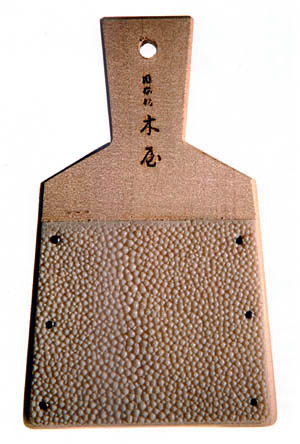
 This oroshigani (grater) is used almost exclusively to grate wasabi, the pungent yet sweet "horseradish" that complements sushi and other dishes. It consists simply of a piece of shark skin nailed to a natural wood board.
Shark skin has been used in Japan for centuries, most notably in sword grips, and here its rough texture - similar to the coarsest sandpaper - makes for a finer grating surface than metal graters provide.
Many chefs believe that metal is too harsh for grating wasabi; others say the extra pressure needed to grate on sharkskin does a better job of releasing wasabi's volatile flavor.


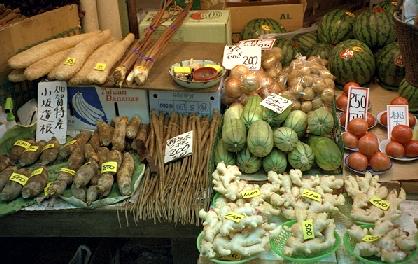
Ohmicho seafood  market, in Kanazawa, specialises in fish from the nearby Sea of Japan as well as local rivers. There are stalls of vegetables too and ..... in the summertime huge blocks of ice are set up in strategic locations and shoppers can cool off by rubbing their hands on them.
Read more : Tokyo Food Page


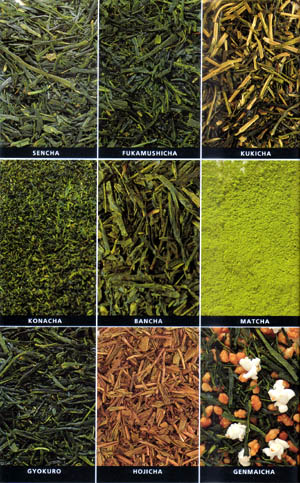
Tea is grown throughout Japan, but the areas that are most well known for their tea are Shizuoka, Kagoshima, and Uji, all of which have types of tea named after them. Many other locales also have their own distinctive local teas with their devoted enthusiasts.
From a book called:
 New Tastes in Green Tea
by Mutsuko Tokunaga


I absolutely loved Japan and the Japanese people, who took me in and showed me such kindness in my travels. It was very unusual in those days for a foreigner to speak Japanese and many people I met had never even seen a non-Japanese person before, except on TV!!   The beauty of and care taken with Japanese public and private gardens is immense and a part of the Japanese psyche and the Shinto religion, which worships nature, ancestors and the spirit. This respect and reverence for nature, whether in the wild or in the home garden, shone through every Japanese person I met. It gives enormous tranquility to life and drew me again and again to various shrines and gardens.
There is a beautiful series of photos at Tom Spencer's The Soul of the Garden and his Images of Japan

Sunday, 10 January 2010

2010 International Year of Biodiversity

Thank you to Patrick for this link.

UN Secretary General Welcome Message for the 2010 International Year of Biodiversity

We are so lucky here in Australia, in so many ways. In relation to biodiversity and things of natural wonder, much of our country is still in its pristine state and none more so than the Lake Eyre Basin of the inland , which covers 1/6 of Australia, an area about the size of France, Germany and Italy combined. The flood waters in eastern Australia last year have been making their way inland ever since, not out to sea,  and have filled Lake Eyre for the first time in 50 years or more.Thousands of people go to see it; it is like a pilgrimage. It defines Australians. Watching this on TV even, makes me feel something I cannot describe.... 

The ABC screened a documentary on it and it is now on iView. It is worth watching on this hot, dry day in South Australia.

http://www.abc.net.au/iview/#/view/490862

Monday, 4 January 2010

SUMMER....READING ON THE VERANDAH, LISTENING IN THE CAR AND WATCHING ON TV-ish

It is an absolutely perfect summer's day as I sit outside at my little mosaic table with my laptop cord plunging unceremoniously inside through the dog flap in the wire door to the power socket in the laundry! Behind me are my two deliciously delicate begonias, meekly displaying sprays of pink and red flowers on tall, elegant stems, and nodding gently in the cool breeze to the raucous laughter of two local kookaburras. It is hard to concentrate on my writing with these 2 comedians laughing so loudly and unselfconsciously from the branches of a gum tree, only about 10m away from me. One even had what looked like the last thin15cm of a snake hanging out of its mouth at the same time as it was sharing a joke with the other. Now that is something..... Hang on while I go and get my camera.......

While lazing about at the shack, without technology, I read 2 lovely books, both of which happened to be by Australian authors and set in Australia. Kate Grenville's: The Lieutenant is an historical fiction story of an astronomer accompanying the First Fleet's arrival in Australia in 1786, and his close association with some Aboriginal people. This book begins slowly and seems scant and superficial at first but it is worth getting into and develops well, leaving you wishing for more. The other, Amanda Hampson: The Olive Sisters, is set in modern times and is a rare treat of a book, captivatingly telling the story of some Italian ancestral discoveries made by a woman escaping a failed city life..... sounds corny.... but is oh so well written and complex.

In between these, I drooled over Juleigh Robins: Wild Food.... 100 recipes using Australian ingredients. Here is a little taste of Juleigh's introduction, which tells how she and her husband came upon bush tomatoes grown by an Aboriginal community, about 20 years ago.....

....About 2 weeks later, 20 large boxes of all sorts of native foods arrived. Ian and I were like kids at Christmas, and eventually we found the much sought-after bush tomatoes in box number 5, labelled 'katyerr' in the Anmatyerr language. I immediately rang Janet and Rita to thank them and see if some more of these marvelous fruits could be harvested for us..... we said please send as much as they could harvest - after all, how much could anyone gather out in the desert? It couldn't be more than 20kgs, right?..... Shortly afterwards we took our first delivery of 2 tonnes of bush tomatoes!

I am so looking forward to making some of the foods, like bush tomato (solanum centrale) and roast pumpkin risotto, and fig, fetta and pomegranate salad with wild rosella (Hibiscus sabdariffa) and pepperberry (Tasmannia lanceolata) syrup, and wild lime (Citrus glauca) friands.

The ingredients are available through Robins Foods (branded Outback Spirit), in partnership with Indigenous Australians, and are sourced from pristine wilderness areas from the Top End and the Central Desert and from rainforest, alpine and temperate coastal regions of Australia. A guide to retail outlets is included. There are even growing instructions for those of us keen enough to seek out plants for our gardens. 

In the car, on the way to the shack, with no interest in the cricket which was on my favourite station, I was searching the radio waves for something  worth listening to and came across Radio National's The Book Show and later, The Science Show. Now, I am not much of a fan of Radio National on the whole..... full of discussions about classical music minutiae and interviews with artists and dancers and poets .... all much too much about people, for me. But, this particular day I happened across a talk (related to his book) - Nicholas Stern: Blueprint for a Safer Planet.... and how it related to economics and Copenhagen. It sounds rather dull but he is a superb speaker and it is well worth listening to since the whole Copenhagen thing hung very much on his report. (Coincidentally, son Alex also happened to hear this talk.... but he was there in the audience, in Oxford!)

On the way home from the shack a few days later, once more in the car, I tuned in to an hour long reading from Tim Severin: The Brendan Voyage , again on Radio National 729. I absolutely loved the idea of rebuilding a boat out of ox hides and seeing if it could be sailed from Ireland to what is now the USA, by an Irish monk hundreds of years ago.....

The illuminated manuscripts that recount the epic voyage of the sixth century saint Brendan from Ireland west across the seas to an unknown land were long considered apocryphal. But explorer, author and film maker Tim Severin was fascinated by the story they told, and after painstaking research managed to build a replica of a sixth century curragh just as the monks of medieval Ireland would have sailed, and set off to cross the Atlantic. With her small crew, the Brendan - forty nine ox hides stitched over a wooden frame - survived pack ice, storms and inquisitive whales to eventually reach Newfoundland, and prove that it would have been possible for St Brendan to have done so also, thus reaching the New World many centuries before Christopher Columbus.

Having discovered some good things I am hooked on Radio National and have listened to many interesting talks, so often in the car, but also online where the manuscripts and audio are readily available. Lord Bob May: The evolution of cooperative behaviour and Martin Rees: Controlling the Future  are two from this week, both of which I want to write about as they are so stimulating and thought-provoking.

Barb rang me this morning and reminded me about Landline, on ABC TV. Langhorne Creek.... home of Newman's Horseradish

.....while fads will come and go, some traditional spreads are finding new favour in a range of dishes - take the humble but fiery horseradish. This root vegetable began life in Germany, but according to second generation horseradish producer Brian Meakins, when the root vegetable's name was translated into English, a Frenchman botched the job, and what should have been sea radish ended up with an equine identity.

Brian grows and processes Newman's horseradish beside South Australia's Lower Lakes, his father having been given permission to use the name by Fred Newman back in 1947. The Meakins have ten hectares under production, from which they harvest 30 tonnes of horseradish to process and sell to supermarkets and communities around the country.

Then of course there is ABC TV's iView where, for 14 days, you can watch all those things you didn't know were on until someone said "Hey, did you see that great show on TV...." but of course you didn't know and missed! I watched a wonderful thing about a man who wanted to make the world's best chocolate so he sold his home in England and went and set up a cocoa bean farm in South America....

And then there is East of Everything...... Like Sea Change, but about some pretty cool brothers in their 30's / 40's, who inherit a sort of hippy beach resort at Australia's eastern most point. I love Art.... he is complex, creative, romantic, interesting, difficult and attractive. Is there anyone else like Lizzy? 

So, when it's too hot to go to the beach or be in the garden, fill your days with the wonderful world of words.....

Thursday, 31 December 2009

THE AUSTRALIAN YOUTH CLIMATE COALITION

Thanks, Gavin, for sharing this video link with us.

Having 2 boys in their 20's makes this very relevant to me. Young adults today will not take no for an answer, no matter who their leaders are, and they will strive for change. After all, isn't change what everyone wants these days?  In my last post I commented on how so much of our lives these days is focused on change. Why then can't our so-called leaders come to grips with the changes we all need instead of remaining focused on keeping things the same? It is so ironic.


.........So those people who say it can't be done should get out of the way of people already doing it....our future will not be written for us, but by us........

The Australian Youth Climate Coalition is a coalition of Australia's largest youth organisations and over 50,000 young people from across Australia. Our mission to is build a generation wide movement to solve climate change before it's too late, through bringing about short term political impact and long term cultural change.

Find out more about the Australian Youth Climate Coalition

And here are their younger brothers and sisters doing their bit too.... growing, cooking and eating gourmet food at Primary School.... this little video clip that Maggie put on a few days ago is fabulous. Of course I knew about this scheme but it is so much more powerful when you watch it happening right here, in Australia. Primary school kids cooking fennel risotto, cabbage and potato fillo pie and a leafy salad with crutons, for the Australian  Minister of Education.....all from vegetables they have grown at school.... how good is that!!

Friday, 18 December 2009

A LITTLE SNIPPET OF WISDOM FOR COPENHAGEN

Sometimes something good comes from waiting to be served in a busy shop. I read a little gem earlier today. The wording may not be quite accurate but the gist is this.......

It is not what lies ahead of us nor what lies behind us that matters most, but what lies within us

I wonder what lies within each of the world's political leaders...... I am not sure it is to them we should be entrusting the future of our planet.

I have not written any of my usual diatribes about the politics of living a greener life for a year or so. There are lots of people like Gavin doing a great job of it and I just have enjoyed leaving them to it. Being in France for 6 months was a nice way to live in ignorance of local issues as my French is not up to more than a chat about manure, chooks, vegetables and the simple things in life. Occasionally I read about floods and drought in Australia on the ABC website, after talking to my mother on skype on Wednesdays because she kept me up-to-date on things Australian.

It is my nature to encourage good things and not dwell on the bad and I get so excited about growing food and seeing my bok choys grow faster than Jack's beanstalk. I am also now looking forward to getting involved in the Food Connect programme, helping Chook with her garden and continuing to help Hugh with his. But that doesn't mean that my blood has not been boiling silently, behind the scenes, during the times I have been back in Adelaide.

I have no intention of adding to the trillions of words already written about the hopes of the peoples of the world for strong leadership in Copenhagen. They are doing their best, those politicians, but they are just that, politicians, mostly with a background in law, economics or just politics. If our leaders were artists or naturopaths or organic farmers we would be in with a chance. If they went there with a passion for nature, human health and vitality or caring and sharing I would have confidence in their words. But they don't. They come from the hard edge of town; from making business deals (usually badly), juggling popularity for re-election with rocking the economic boat as little as possible.

What lies within us matters so much because it is from there that we are driven to act. Words are cheap; actions much harder and a far truer display of our real selves. If a person has spent decades religiously pursuing a career in law or economics, is it fair of me to say that I cannot see them as being passionate about butterflies in their garden or sharing seeds of their favourite lettuce or re-using stuff from a neighbour's hard rubbish to make a chook run? Which of them would wear a second hand suit or carry a second hand brief case to the meetings? Is there a single one who has insisted they eat only local food while in Copenhagen? Did any of them seek out the local seedsavers group since they were going to be in Denmark where Skrubtudsen from The Toad's Garden lives? You may laugh, but these are the people we need making decisions for our planet; people with a passion about the planet. I don't mean airy fairy dreamers, but people whose daily actions have proved that what lies within is the right stuff for the job.

Saturday, 12 December 2009

HAPPY FIRST BIRTHDAY TO HUGH'S GARDEN!

 Hugh's patch


It was the first birthday of Hugh's vegetable garden this November! Back in 2008 we cleared away years of rubbish and neglect from the yard of the house he rents. And then we dug out some of the acres of concrete.... a shocker of a back yard to start with!

image

The soil is very sandy and in places it is just white sand, being so close to the beach. We dug in bags of compost from SA Composters, a brick of coconut fibre to hold the moisture in and Rapid Riser as the "soil" seemed so lacking in anything at all.


image


He started off wanting neat rows and vegetables grouped nicely.... and didn't like my approach of inviting nature in to work for you by having things all mixed up.

Everything grew like mad and he was so proud of it all.


Then the earwigs and caterpillars discovered it. He made earwig traps and sprayed Dipel for the caterpillars but thought there must be a better way. He bought a couple of books and studied them well.... Jackie French's "Towards Backyard self-sufficiency" and Lolo Houbein's "One Magic Square". Jacky lives in NSW and Lolo in Adelaide so he did well. Funny he chose these 2 books of the hundreds available at book shops because, unbeknown to Hugh, this Jackie French book was also my first vegetable gardening book a trillion years ago and I had recently met Lolo at Fern Ave Community Garden and thought her book looked great! 

Anyway, the gist of all this was that he began to plant herbs amongst the rows of vegetables. He gradually moved away from rows and went for ....dare I say it.... Mum's more natural approach!

imageimageDuring the year I helped him expand the garden into more of that concrete jungle but the things he grows and what goes where are all up to him.... I am just the worker following instructions these days.... something I am pretty shocking at!


......until now it looks like this! It brings a tear to my eye to see such a wonderful patch of paradise grow from such a harsh beginning and it just goes to show what you can do....


image


So, we sat outside in the garden and raised a glass to Hugh's first year as a vegetable gardener.

May the future bring him happiness and may his garden flourish.

image

See more photos of Hugh's garden here.

....I have no idea why I am having such trouble getting this to post how it is supposed to look. Has Live Writer gone mad or is it me??

Thursday, 26 November 2009

SEMAPHORE... A CONFIDENT, COMFORTABLE, VISIONARY COMMUNITY

The other day Hugh and I were getting some things from the local garden shop here at Semaphore and on the way back to the car I noticed the cafe next door. The word "sustainable" caught my eye and, knowing nothing else about it, I said to Hugh "Let's go there for dinner on Thursday". Now, I rarely go out to dinner, finding it very hard to ever get food as good as that from my own garden. So this impromptu suggestion took Hugh and I both by surprise! And tonight we went there for dinner..... Sarah's Sisters' Sustainable Cafe.

The setting is quite wonderful..... the tables all look out from a curved, semi-enclosed verandah-style room onto the water garden of the garden shop next door and behind! What a clever combination of businesses.... owned by different people, but complimenting each other so well. Past the water garden's trickling nymphs were pots of the agastache that Maggie tells me is so good for attracting bees, benches of herbs and rows of vegetable seedlings etc..... I was bound to enjoy this meal !

Ordering was quite unusual.... the lovely woman had not much idea what was going to be served except that it had soup, 2 entrees plus salad and 2 desserts..... for 2 people. It was called chef's choice and one of the sustainable things is that they try not to waste food, using up ingredients and introducing new things as required. The people at the table next to us ordered first and we looked with interest at what they were getting, expecting ours to be the same..... but no! We were given something different, all of it outstanding. The coffee was good but not great and Hugh reckons that the best coffee in Semaphore is to be had at The Corner Store, where Abbie's dedication to quality puts her far above the rest.

Anyway..... I have not enjoyed a meal at a restaurant this much for a long time. And as we called around the corner of the kitchen to compliment the chef, out he came, very interested in what we thought, who we were, why we were there and so, as Pattie would say, we started to chat about this and that.

His name is Stuart and he is helping set up a Semaphore group to promote the kind of lifestyle that most people reading this blog know a lot about already.... low impact, low input, organic, healthy living where sharing is the norm and a simpler, greener, community-oriented life the goal. They have a location in mind on Semaphore Road, down near the beach front, and want to invite genuine, community-minded people to be involved in getting it off the ground before Christmas.

I have fallen on my feet here.... having only been back from France for less than a month I have already managed to meet several local, green shop owners and given them dozens of my "The Wise Cook's Garden" brochures, have promised them samples of my herb and salad pots as well as my cooking and now being invited to join some of these grass-root discussions about my favourite topics! It is amazing how a passion leads you to sharing it .

Hugh is equally keen to be involved and has offered his skills as a fabulous young chef, enthusiastic food gardener and ability to inspire others. It is all very well for us old farts to harp on about what everyone should be doing but if we are to ever have the next generation follow our lead, we need people like Hugh out there demonstrating the fun and taking a leading role. I sincerely hope that Stuart and others can see the importance of accepting Hugh's offer to give to his local community in such a wonderful way.

This Sunday, November 29th, from about 11am there will be the Semaphore Street Fair..... not a strictly sustainable day but promoting co-operation between developers, traders and residents. Stuart says it will be something unique in this way and be the start of a Semaphore community spirit that will aim to maintain the culture and history of the past, meld it with its unconstrained present and ensure that the Semaphore of the future is unique, green and a comfortable and welcoming place to be.

Semaphore Community MArkets BannerThe following Sunday, Dec 6th, and every subsequent first Sunday of the month, is the Semaphore Community Market at St Bede's, 200 Military Road..... come along and have a look.... I will be there and will write about it afterwards!

Wednesday, 18 November 2009

Beauty and the Beast

 Here in Adelaide we are in the midst of an unbelievable heat wave. I remember November as being mostly pleasant days in the mid 20's (no, not my age, silly..... the temperature, in centigrade!) This November has been 2 weeks of temperatures from 37 - tomorrow's 43C!

image

I had an email from Maggie saying Bob and I are thinking date palms, saltbush and goats for next summer!!!! Being lateral thinkers with not much in the way of traditions, we Australians think nothing of mixing together all of history and geography and coming up with something to suit our situation!

My reply said....I might take up camel riding and take tours of the Semaphore sand dunes.... stopping at oases filled with date palms and pomegranates.... looking for mirages, mermaids and naked nymphs.... and finish by visiting unshaven Arabs in beach tents, drinking strong Farmers Union Iced coffee!

imageI am staying with son Hugh at Largs Bay.... obviously this is near the sea.... and most evenings I wander down to the beach before or after dinner, for a swim or a walk or both. 

Tonight on the beach it was so so beautiful; a light cool breeze coming across the sea, sailing boats dotted about, families and dogs walking and paddling and a few swimming. Everyone smiling and relaxed; lots of tails wagging. The sky was wild with clouds; some high. some lower, some dark, some white, some fluffy, some streaky and then, ever so slowly, the sun slid down and down towards a gap near the horizon and just before I left, the sun broke through. The whole world turned to liquid gold. The people with fishing lines on the jetty were a silhouette, painted onto a golden sea.

Nature truly excelled herself, as if to say.... here I am putting on a show for you tonight so don't be angry tomorrow, when I rage with fire and wind and turn into a hellish furnace of furious heat.

It is no wonder Adelaide has been one place, on this busy and crowded earth, where people have revelled in a relaxed and care free lifestyle, not caring much for showiness or greed. What more could you need than an evening walk on the beach and a BBQ out the back in the garden? Stretched out along more than 50kms of coastline, none of the million or so people are very far from the sea or a sea view. For most of the year life is very much an outside affair.

image

But you cannot walk on the beach when the sand burns your feet, the sun blisters your skin, the glare blinds your eyes and the air is too hot and dry even to talk.

What is going to happen to good old Adelaide if the shocking temperatures we keep having even so early in summer keep killing our food gardens, drying up our water supplies, destroying businesses and agriculture, making tempers fray and turning our city of green spaces into a city of dust and destruction?

Friday, 16 October 2009

16th October WORLD FOOD DAY by Roger Doiron

Published on Thursday, October 15, 2009 by CommonDreams.org

On World Food Day: Crunching the Numbers

by Roger Doiron

Tomorrow is World Food Day and since I can't invite you all over for dinner, I thought I'd serve up a smorgasbord of facts and figures about the way the US and the world eat or don't eat, as the case may be.

The menu isn't all bad, but I'll warn you that too much of it could lead to mental and emotional indigestion.  The good news is that if you live in the developed world and you don't like what you're served, another option is only a few steps away or, in the case of online food-for-thought, mouse-clicks away.  That said, I'd urge you to finish your plate and consider sharing a bite with others. 

If I sound like a parent, it's because I am which is one of the reasons I feel compelled to mix these eclectic issues together in one big pot.  If we can all start seeing the connections between food, health, and the environment and teaching our children to do the same, perhaps we can serve up a more palatable offering of food statistics in their lifetime. 

So, let's dig in:

  • 1: number of new kitchen gardens planted at the White House this year AP
  • 1943: the last time food was grown at the White House White House
  • 20 million: the number of new gardens planted in 1943 LA Times
  • 40%: percentage of nation's produce coming from gardens in 1943 LA Times
  • 7 million: estimated number of new food gardens planted in the US in 2009 NGA
  • $2000: amount of savings possible per year from a 40' x 40' garden KGI
  • 90%: percentage of fruit/vegetable varieties lost in the US the last 100 years CNN
  • 3500: number of vegetable varieties owned by Monsanto Monsanto
  • 18,467: number of new small farms counted in the last agricultural census USDA
  • 4,685: number of farmers markets nationwide USDA
  • 4,100: number of Wal-mart stores and clubs in the US Wal-mart
  • 187,000 ft2 : average area of a Wal-mart superstore Wal-mart
  • 60,112 ft2: average area of a farmers' market USDA
  • 9.5 million: number of imported food shipments arriving in the US each year Huffington Post
  • 226,377: number of establishments registered to export food to the US Huffington Post
  • 200: number of on-site inspections of these establishments conducted by the FDA last year Huffington Post
  • 76 million: number of people who fall ill each year due to food poisoning CDC
  • 50 gallons: volume of sugared beverages consumed per person in the US each year LA Times
  • 22,727: number of Olympic-sized swimming pools those beverages would fill Answers.com
  • $15 billion: annual estimated revenue of a penny-per-ounce tax on soda LA Times
  • $20.5 billion: Coca-Cola's gross profit in 2008 Coca-Cola
  • 72 million: number of American adults considered obese CDC
  • 33%: percentage of US children likely to develop obesity or Type 2 diabetes CDC
  • 10-15 years: average number of years their lives will be shortened as a result CDC
  • 57 years: average age of the American farmer USDA
  • 25 days: average shelf-life of a Twinkie Snopes
  • 350 parts per million: sustainable level of CO2 in atmosphere 350.org
  • 390 parts per million: current level of CO2 in the atmosphere NOAA
  • 31%: percentage of human-caused greenhouse gas emissions attributable to food and agriculture IPCC
  • 2020: year by which many geologists feel the world will have reached "peak oil" production UK Research Centre
  • 10 calories: average amount of fossil fuel energy required to produce 1 calorie of food energy in industrialized food systems Cornell
  • 29,100 calories: estimated fossil fuel calories required to produce one order of Outback Steakhouse Aussie Cheese Fries Men's Health
  • 1 billion: number of hungry people in the world in 2009 FAO
  • 9.1 billion: projected world population in the year 2050 US Census
  • 70%: percentage increase in global food production required to feed that projected population FAO
  • 70%: percentage of world's fresh water used for agricultural purposes UNESCO
  • 1.8 billion: number of people expected to experience "water scarcity" in the year 2025 UNEP
  • 0: number of new, oil-rich, water-rich, fertile and inhabitable planets we are likely to discover in the next 40 years
  • 1: number of people needed to make a positive difference in any of the above: you!

Roger Doiron is Founding Director of Kitchen Gardeners International, an IATP Food and Society Fellow, and, if you believe the folks at Huffington Post, one of the top Green Game Changers of 2009.    

Sunday, 9 August 2009

Food for Thought

During the agriculture course in 1924 that laid the foundation for Biodynamic agriculture Rudolf Steiner stated:

There is practically no field of human endeavour that does not relate to agriculture in some way. Seen from whatever perspective you choose, agriculture touches on every single aspect of human life”

What we eat has an effect on our surroundings, the rural landscape, traditions, and the biodiversity of the earth & well being of our communities.


When we choose food to put on our plate we have great power...

In agriculture our choice determines the variety of foods grown, today fewer varieties are available & we are suffering loss of diversity in our foods. Everywhere you go there are the same foods presented? Many foods are demanded year round outside their natural season & the consumers wonder why it tastes like cardboard!

Our choices also determine how & where the food is grown.


We need to consider how food is produced, and how it affects environmental sustainability. Can it enhance the environment and protect biodiversity?

While the principles behind organic agriculture are sound, like promoting agriculture that has a low impact on the environment and reducing pesticide and herbicide use. However when organic agriculture is practiced on a massive and extensive scale is very similar to conventional monoculture cropping and therefore organic certification alone should not be considered a sure sign that a product is grown in a sustainable way. Although most of the traditions methods use organic techniques, very few are certified, due to the high costs of organic certification. I know from experience this is true. Our farm was the first farm certified in South Australia, we where certified for 13 years until the costs out weighed the benefits.

Our choices also determine the quality of life for rural communities, in fact whether or not they exist. For too long food has been too cheap. The farmers themselves need to be paid a fair price for their produce and the farm workers require fair wages & conditions. Large supermarkets force the prices to farmers down while maintaining a large profit for themselves.

As well as growing some of our own food and experiencing the magical unique taste that comes only from your garden we can also develop a sense of how food is produced. We then need to become very parochial and support local producers rather than supporting food that has travelled around the world.


I think the manifesto that came from Terra Madre, a Slow Food meeting I attended in 2004 attended by 5000 small producers representing 130 countries sums it up best

Quality Food must be:

  • Good. A food’s flavor and aroma, recognizable to educated, well-trained senses. Thus reflecting the competence of the producer and of choice of raw materials and production methods. This also reflects culture as what tastes good to me may not taste good to someone else
  • Clean. The environment has to be respected and sustainable practices of farming, animal husbandry, processing, marketing and consumption should be taken into serious consideration.Every stage should protect ecosystems and biodiversity, safeguarding the health of the consumer and the producer.

  • Fair. Social justice should be pursued through the creation of labor conditions that are respectful of man and his rights and capable of generating adequate rewards; through the pursuit of balanced global economies; through respect for cultural diversities and traditions.

Good, Clean and Fair Quality is a pledge for a better future.

Good, Clean and Fair quality is an act of civilization and a tool to improve the food system as it is today.

Everyone can contribute to Good, Clean and Fair quality through their choices and individual behavior.

More about Slow Food

I would add LOCAL and SEASONAL to any food I purchase.