Showing posts with label Seasons in the garden. Show all posts

Saturday, 10 September 2011

Colourful Spring Flower Salad

It is Spring here on the Adelaide Plains, there are flowers everywhere and trees are bursting with beautiful blossoms.

We are still having lots of rain and it is cold at night so our Kale is still growing well and the lemon tree is bursting with large juicy lemons.

The cows, sheep and goats in the paddocks near us are enjoying munching away on lush green pastures.

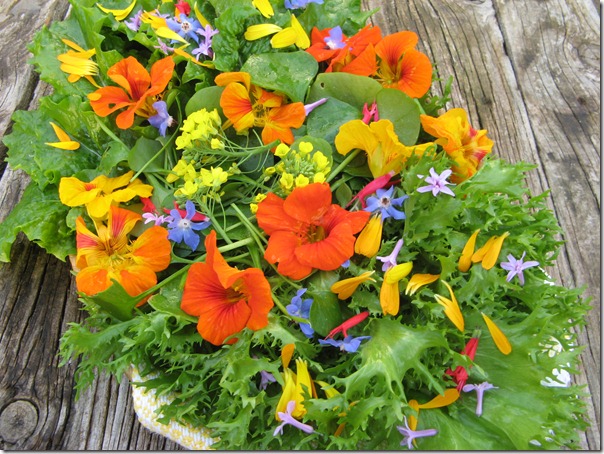
Nasturtiums are making a colourful display in the garden. Eating nasturtiums helps prevent hay fever as well as making a colourful tasty salad. 

Salad for Buddha House-1

Borage flowers, pineapple sage flowers, garlic chive flowers, brassica flowers and calendula petals are all edible flowers. With all these gorgeous colours I am sure they all contain wonderful healing properties.

When you let your herbs and veggies go to seed they just reappear next year and the joy of fresh seasonal produce is a pure delight.

September is a lovely month here in Adelaide, check out the Australian Open Garden Scheme if you want to visit some amazing gardens.

Happy Gardening and enjoy your greens and flowers.

Saturday, 28 May 2011

Brilliantly Coloured Autumn Fruits and Leaves on the Adelaide Plains

Colours of Autumn-2

It is Autumn in Adelaide South Australia, nearly winter.

Here are some of the gorgeous coloured fruits we are enjoying at the moment.

Soft juicy beautiful flavoured persimmons we bought at the last Rare Fruit Society meeting.

Beautiful mauve and purple lilly pillys we forage from local trees. They are large and juicy and we love eating them straight from the trees.

The last of our excel figs  not as sweet as they were a month ago but still yummy.

Beautiful jewel red pomegranate seeds just from our tree. Once again we just love these seeds.

Peoples citrus trees are covered with mandarins, oranges, grapefruit and lemons almost ready to eat and make delicious marmalades from.

As we take Niki and our grandson for walks it is wonderful to see brilliant trees covered with vibrant yellow, orange and golden leaves, red and purple coloured vines, rainbow coloured flowers and bushes, bright yellow and pale pink roses and bright green grass after the wonderful rain we have had.

Autumn leaves are being raked and thrown under bushes for mulch or added to compost heaps.

There are loads of birds around I guess they come down from the Adelaide Hills which are 5 minutes drive away but heaps cooler than here on the plains.

Our winter green garden is starting to produce Asian greens, rapa and all the wonderful herbs we add to our meals.

We still have capsicums and chillies ripening, lovely bunches of parsley and rocket.

No longer am I sad that tomatoes have disappeared because Autumn and winter has replaced them with exquisite flavours, new recipes to try and enjoy.

Sunday, 27 March 2011

Avocado, Basil, Rocket and Tomato Bruschetta

Bruschetta-3

Summer on a plate! To make this yummy bruschetta first plant some seeds.

Watch them germinate, water and care for your plants for several weeks until finally you have beautiful tomatoes, basil and rocket.

Harvest your creations and mix them together with some cracked pepper and a drizzle of local olive oil.

Toast some Paolo’s Grain Sour Dough, rub it with fresh garlic and top with your garden creation.

More to say? No just munch away!

Wednesday, 9 March 2011

Local Fish and Chips, Garden Salad and Baked Excel Figs for Dessert

Dinner tonight all cooked by the gardener not the cook!  Pretty delicious!

Thanks Julie for the potatoes.

Local Food-4


Local Food-12

Wednesday, 23 February 2011

Summer Tomatoes – Yum!

Our Tomatoes

I think home grown tomatoes are most kitchen gardeners favourite vegetable.

We have tomatoes from seeds we germinated and a lot of self seeded tomatoes which just appeared in our garden when we spread out the contents of our worm farms.

We eat the tomatoes as a snack straight from the vine, with our basil and rocket salads, add them to frittatas and just freeze them whole to be cooked with onion and thyme in autumn when the vines have wilted.

We are having warm humid weather in Adelaide at the moment and new tomato self sown seedlings are appearing in the garden.

March will be warm so I expect we shall have tomatoes and fresh basil for a while yet.

The delicious pinkish tomato is called Eva Purple Ball, it is a gorgeous looking tomato.

Tuesday, 8 February 2011

Crunchy Summer Green Bean Salad

Green Bean Salad-7

Summer crunch for lunch, straight from our garden.  Blanched green beans, green peppers, tomatoes and crispy red onions tossed with fresh garden herbs, olive oil and cider vinegar. YUM!

Makes all the seed saving, nurturing of seedlings, preparing garden beds, planting and watering worth the time and effort.   

Saturday, 29 January 2011

Our New and Improved, Shade Structure made completely from Recycled Materials

New & Improved Shade House-2

We usually drape shade cloth from our trees when Adelaide temperatures heat up to 40 degrees Celsius.

So with 42 degrees forecast for tomorrow, this morning was spent erecting an efficient shade structure.

Last week a friend dropped off a 3 metre by 4 metre gazebo frame destined for the tip.

After a bit of experimenting with the pieces we eventually had the gazebo frame in place to provide support for the shade cloth over our unusually shaped veggie garden.

Well at the end of the day I can say our veggies were protected from the scorching sun.  Bees still feasted on the flowering plants, there was good air circulation and tomatoes ripened in the warm shade.

Our usual system was clumsy, hard to get under and far too humid.

This new and improved version is fantastic, we just hope it does not leave the Plains here for a flight to the Hills if the famous Adelaide gully winds pick up.

Friday, 21 January 2011

Middle Eastern Spicy Chickpea Salad


Batty's Garden-58

Today we had lunch with some friends so I made this delicious salad.

I always use organic dried chick peas, soak them overnight, drain them and then simmer them in fresh water until tender then drain them.

When cooked I sprinkle the chickpeas with salt, cracked black pepper and a little paprika and olive oil.

For this recipe I heated a couple of Tablespoons of Middle Eastern spice mix in a little oil to infuse the flavours.

I added this to the chick peas with some finely sliced red onions, the juice of 2 lemons, some chopped tomatoes, chopped cucumber, a dollop of tahini, a handful each of chopped mint and parsley, more black pepper, paprika and crushed garlic.

I served it on a bed of wild rocket.

It is great to have all these lovely herbs in the garden to flavour your food.

Most folks brought summer produce from their gardens including eggplant dip, zucchini fritters, tomato and basil salad and cold rolls filled with home grown veggies and herbs.

All these dishes make delicious, healthy, summer salads or vegetarian mains.

I was going to say I love summer garden produce, but then I love winter produce just as much. Whatever season it is there is always something to make flavourful meals with when you grow lots of vegetables & herbs in your garden.

Tuesday, 11 January 2011

Red Capsicums, Stuffed with Tomato and Basil Rice

Summer in Adelaide brings fresh tomatoes, peppers, basil, spring onions and other herbs.

So when unexpected vegetarian guests arrive, stuffed capsicums make a delicious quick meal.

I served these peppers with a creamy mushroom sauce, roast potatoes and rosemary roasted potatoes and a green garden salad with fresh snow peas and more basil, DELICIOUS!!!

Peppers-7

Peppers-12

Summer veggies at last, I can hardly wait for more tomatoes and cucumbers to ripen to make a summer fresh Gazpacho.

Monday, 13 December 2010

Mulch Making Monday

Seedsaver Maggie-16Mulch Making-5

Mulch Making-4Mulch Making-11

We have been trying to find time to put all our winter prunings through the mulcher for weeks.

Today we finally managed in 2 hours to put this great pile of organic matter through the mulcher and spread it all over some of our garden beds as summer mulch.

I still have lots of dried grass cuttings which I shall use to put around small seedlings.

Lovely organically home grown and processed MULCH for our summer garden.

Lucky we put the mulch down today, tomorrow is going to be 35 degrees Celsius.

Adelaide has lots of rain in winter so dried grass cuttings provide ample mulch and summer prunings will be mulched and then composted.

Wednesday, 24 November 2010

Rosella Enjoying Salad Burnet Seeds in the Garden Today

Rosella in the Salad Burnett-16

We save seeds to plant out in our next seasons garden.

We let plants go to seed so they self seed and reappear in our gardens as the seasons change.

We save seeds to give to others.

We save seeds so we have nourishing food next season.

We let things go to seed to enjoy the beauty of the flowers and seeds.

We let things go to seed so bees and birds and other insects are attracted to our gardens.

These visitors pollinate, eat bugs and keep our gardens healthy.

SEEDS, SEEDS, SEEDS!

Tell us a tale of your seed saving adventures!

Sunday, 22 August 2010

World Kitchen Garden Day August 22nd 2010

Welcome to World Kitchen Garden Day from Adelaide, South Australia.

It is winter here which means lots of winter rain and mild temperatures.

Our garden looks lovely with masses of Asia greens, Italian broccoli rapa, silverbeets, leeks and spring  onions, parsley, fenugreek, coriander and almost every kind of herb you can think of.

We have rocket, rapa and coriander going to seed.

We have calendula's, German chamomile and speckled borage everywhere.

Today we have friends coming to see our garden and then a large afternoon tea at another kitchen gardeners home.

So I look forward to today and I hope you all enjoy your garden and what ever you have planned for today.

Greetings from Adelaide.

Maggie

Herbs & Olives

Saturday, 15 May 2010

THE COWS ARE BACK!

  Cows

If you follow this blog you will be aware that grass in Adelaide, unless watered, turns golden and does not grow in summer because we have very little summer rain. But as soon as the rain comes in Autumn, the grass grows again.

So the neighbouring agricultural high school paddocks are green again.

It is then that the cows are put back in the paddocks to graze on the winter grasses.

The goats appeared in a neighbouring paddock a few days ago and today the cows are back!

The animals are from the local agricultural high school and are kept in back paddocks during summer but in winter they are in the front paddocks and many local people bring their children to see the animals.

So now my young grandson will be elated, because all summer I have told him as we gazed at the barren, sun dried paddocks, when the rain comes, the grass will grow and when there is green grass in the paddocks, the cows will come back.

I repeat myself many times about some things I would like him to be interested in and remember.

WOW! the cows are back or WOW! the seeds we sowed have germinated and WOW! this parsley is from the seed we saved then threw over the garden in summer, WOW! this lettuce is yummy, WOW! look at all the worms in the worm farms.

Why? well it is important for us all to be aware of nature and the seasons.

The seasons bring many changes in our gardens and lives, foods appear once a year and then they are gone until next season.

Each month brings a different fruit or vegetable to enjoy, preserve or let go to seed so it can be replanted next year at the appropriate time or just left in the soil to germinate when the conditions are right for it.

Next week when he visits and we shall enjoy watching the cows chomp on the green grass and wander the paddocks.

And why are their 5 cows this winter and there were 10 cows last winter, well that is another story for another day!

We love the cows and we love the fact that they are eating lovely green grass, and that they look so healthy and content.

Saturday, 8 May 2010

Pine Mushrooms Asian Style

Autumn in Adelaide brings chestnuts and pine forest mushrooms.

Today we spent quiet afternoon wandering a friends property gathering mushrooms for dinner.

We arrived home to walk the dogs then head for the kitchen to prepare these delicious mushrooms.

We cleaned and sliced them and then fried them in a little olive oil with lots of fresh garlic, chilli and grated ginger.

We cooked some Hakubaku soba noodles and added a little with sesame oil.

We returned all the mushrooms to the pan and added freshly sliced Asian greens, fenugreek and coriander leaves and some tamari and already cooked chestnuts. We bought the chestnuts last weekend from Nirvana Organic Farm they are fantastic.

We served the mushrooms with the noodles. They were absolutely delicious, I reckon we might head to the forest again soon.

And I think we shall also prepare this delicious, best in town 3 minute noodle dish.

Mushroom Foraging-11

Pine Mushrooms Asian Style-2

Friday, 7 May 2010

BORAGE the Herb of Gladness, Joy and Courage returns to the garden

Speckled Borage 

We love our speckled borage scattered through our winter garden so we always let some go to seed and then reappear where ever it chooses.

Those of you have grow borage before know that it will reappear everywhere. But is is easily removed to pots or the compost. Some people do not like growing borage because it would take over your whole garden if you let it.

We love borage in the garden because the neighbourhood bees love borage and appear in mass once the beautiful blue flowers appear in spring. We love the local honey it is dark and flavourful and makes delicious honey mead. We also use that honey in any thing we bake or sweeten.

Some people eat small quantities of the leaves in baked goods, we add them to the compost.

But the flowers we add to drinks, salads, fresh fruit and cordials.

Here on the Adelaide Plains it is starting to get colder at night. We have had sufficient rain for the garden and the seeds we have planted are germinating and need thinning out or moving.

Spring Flowers

We call our winter garden our green garden because with limited space available we mainly grow green leafy vegetables and lots of herbs.

So the menu here changes from zucchini fritters to spinach fritters. The soups have lots of Asian greens, chillies and chives added to them. We shall be having mustard greens, fenugreek and coriander added to curries. Spinach pies will reappear filled with all sorts of green vegetables, parsley and herbs.

As the delicious flavour of fresh tomatoes fades to a memory, citrus trees are ripening ready to be added to salads, muffins, fritters, drinks or just eaten fresh.

We are so lucky here in Adelaide to be able to grow  and enjoy fresh vegetables and fruits all year.

But the herb of the week here is beautiful borage.

Dorothy Hall in her 1975 copy of The Book Of Herbs suggests a variety of uses for borage.  She says borage is the “Herb of Gladness” and is a great tonic which gives courage and joy to warriors! It is used in teas, salads, salad dressings and as the ideal companion plant for strawberries.

How do you use borage?

Tuesday, 20 April 2010

Autumn arrives in Adelaide and the Adelaide Hills

Autumn in the Adelaide Hills

On Sunday we went to the Stirling Autumn Festival to buy some organic seedlings from Diana and Jen. We loved the scarecrows on display as well as the music and all the other plant stalls.

We went to Winterwood Garden and enjoyed the African music, food and garden.

Then we went to visit Deb’s Nirvana Organic farm to buy some fresh Chestnuts for roasting.

Everywhere there was gorgeous orange and red autumn leaves and lush green grass after the recent rain.

So Autumn has arrived, our seedlings and planted seeds are growing and we are looking forward to eating all the Asian and Italian green vegetables we have planted or sown.

The paddocks across the road have tinges of green grass.

All summer as my grandson and I looked at the bare dry, golden paddocks I would say to him “ when the rains come the grass will grow and when the grass grows then the cows will come back to that paddock to eat the grass”.

He is only two so I was wandering if he would remember this. Today was the test. So I asked him as we gazed at the paddock and the tufts of green grass what would happen when the grass grows and the paddock is green again, what will happen?

His reply came quickly “Cows”, yes, well done little one, the grass will be green soon and your favourite cows will be back in the paddock munching away at the grass and having a feast! And when you come to visit you will be able to watch these ever so big cows lead a happy, healthy life grazing in the paddocks.

Saturday, 17 April 2010

AKWAABA and the Stirling Autumn Garden Festival -Tomorrow

Experience Africa in a Garden Celebration.

All proceeds to Australian Sponsorship 4 African Kids.

This garden, Winterwood, is an amazing garden with 2 acres of trees, shrubs, orchard, vineyard and flower and vegetable gardens.

There will be African food stalls, craft, cooking demonstrations, children's activities, African children's choir, African Drummers and a whole lot more.

AKWAABA Poster


Back in Stirling.

The Stirling Autumn Garden festival will also have gardening talks, stalls and everything you need for your garden.

Diana and Jen from Bickleigh Vale Farm will be selling a huge range of organic seedlings for your winter garden.

Stirling Autumn Garden Festival 18th April, 10am – 5pm

  • Major Sponsor Adelaide Hills Magazine will be launching their Souvenir Autumn 2010
    edition.
  • Our guest speakers Sophie Thompson and Trevor Nottle will be presenting talks on
    sustainable gardening, gardening in climate change and be also signing books which are for
    sale on the day.
  • Over 50 stalls under the magnificent old oak trees in Druid Avenue will have information and
    products for the garden enthusiasts including stalls by nurseries, garden designers, garden
    sculpture and garden societies who will be showing their garden related products.
  • Singer Jennifer De Grassi will provide music to add to the ambience of the day.
  • Free shuttle buses will be provided to take people to the stunning Open Garden, Heritage
    listed Beechwood (entry $6.00) and to the inspiring two acre garden of Winterwood on Old
    Carey Gully Road Stirling for Akwaaba, an African Garden Celebration with Dorinda Hafner
    providing cooking demonstrations and African Drummers and African Children’s Choir,
    African food stalls and more The entry fees of $10.00 adults, $5.00 children and $25.00 per
    family. All proceeds go to the Australian Sponsorship for African Children charity.
  • The shuttle buses will also stop at Aptos Cruz Gallery, where visitors will find an amazing
    collection of treasures – art furniture and more. This is also the location of Siemers Indian
    Restaurant and The Table Restaurant where enticing menus will satisfy the palate.
  • There will be a scarecrow competition again this year with approximately 40 scarecrows
    made by local businesses and schools being displayed in the scarecrow gallery.
  • The Mt Lofty Districts Historical Society will be conducting one and a half hour tours ($15.00)
    of Stirling, Crafers and Summit Road including expert commentary by one of their
    knowledgeable guides highlighting some of the heritage gardens of Stirling plus a drive
    through the magnificent Japanese Garden of Thorpe.
  • These tours can be pre-booked through
    the Customer Service Counter in the Stirling Library
  • Tuesday, 13 April 2010

    Stirling Autumn Garden Festival

    image One of Stirling's oldest and most famous private gardens will be open to the public as part of the Stirling Autumn Garden Festival on Sunday 18 April 2010.
    The festival, held under the exquisite old oak trees of Druid Avenue, will feature stalls by garden designers and nurseries and garden art. Food at local cafes and restaurants will be available. Guest speakers during the day include gardening expert Sophie Thomson and others.
    As part of Australia's Open Garden Scheme throughout the day shuttle buses will transport people free of charge to the garden (entry to the garden is AUD6.00), while other gardens will feature in an historical coach tour (entry AUD15.00) offered by the Mount Lofty Living Garden History Centre.
    Be sure to check out the more than 40 scarecrows - made by local schools and businesses - which will line Mount Barker Road during the week leading up to the festival.

    Wednesday, 17 February 2010

    HUGH'S LITTLE PATCH OF THE MEDITERRANEAN

      imageBy now our summer vegetables are all established and should be producing well but with another heatwave looming down on us, it is hard to stay positive about gardening in summer, in South Australia. I think a covering of the white 50% shade cloth is the answer to keeping leaves and other soft vegetables going well. To a human the white does not seem to provide a sense of shade but to the plants it is the perfect solution as they need to keep photosynthesising to survive and only the white shade cloth allows the full range of sunlight through, but cuts the intensity by 50%. In my little shade house made of this fabric, lettuce and other leaves flourish and nothing is as uplifting as walking in and seeing such happy plants, even though temperatures may be in the 40's. Have a look at Scarecrow's garden for ideas on how to erect the white shade cloth.

    image At Hugh's he has developed a different approach, as we have had the time to toss ideas about together and time for him to learn little by little by direct experience. Living in a rented house with a yard completely covered in concrete has made him learn to be creative and to adapt to what is cheap, easy and possible. For example, he has lettuce and other leaves growing under the tall amaranthus, making a perfect microclimate. After the accidental success of the bok choy planted around the bird bath, Hugh has put a large pot of water amongst the amaranthus to raise the humidity and on hot days this certainly seems to work, as amaranthus in other places tend to get burnt edges on the leaves. It is amazing how fast this water evaporates in our searingly dry heat.

    The floor of the tomato bed is covered in herbs such as the Laksa herb, garlic chives, various basils and tarragon. The capsicums are planted so as to be shaded in the late afternoon only; galangal, beetroot and beans receive afternoon shade from the neighbour's gum tree while sweet potatoes and purslane creep between the eggplants. There is no shade cloth,other than the little shade house only careful planning and, despite the abominable mass of concrete, the garden is flourishing like an oasis.
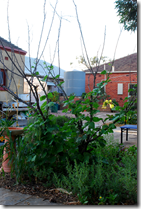
    imageOf course there have been casualties! The biggest problem that is very hard to alleviate is the wind which rips through everything, bouncing off fences and rattling even the seemingly most protected areas of the yard. Luckily tomatoes love wind and it keeps away diseases but a week of dead calm has seen the arrival of some mites..... now we are hoping again for the wind to return! Whether it was the wind or something in the soil we don't know but the corn was a disaster, after starting strong and magnificent and everything planted in that bed has failed to thrive..... cucumbers, beans, even zucchinis. But the idea was good.... the tall corn was to protect the cucumbers and the beans were to climb up the corn and everything was supposed to be one big happyimage family!

    Before Hugh became interested in growing fruit and vegetables, a lovely old apricot tree died of neglect. Hugh has sown his tallest beans around the dead tree and this is fast becoming a bean tree. Underneath are also marigolds and echinacea and there is a single comfrey plant establishing itself and hopefully soon it will form a clump from which Hugh can harvest the nutrients said to be inside those magical leaves.

    There is a dreadful little walled section of garden just wide enough to cook the soil in summer so into it we planted native sand dune plants from this area as well as some okra which loves extreme heat and dry soil. At one end some established spring oniony things are doing fabulously too.
    image

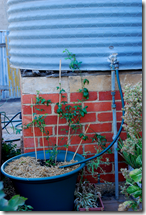
    The water from the rain water tank is used to water those things that suffer most from our salty mains water..... tubs of fruit trees and the salad garden, purposely planted right next to the tank because neither of us believe we should be using pumps... that is something I have written about before and no doubt will again. In the '50's when this house was built, people did sensible things like putting the tank up on a stand to give some head or pressure; today this seems to be all forgotten and people use pumps and make pollution in order to save water !!! To make most use of the vertical space and to keep the tank water cool, Hugh has just planted 3 different passionfruit in tubs, after covering the tank in chicken wire for them to climb up..... what terrible English this is but I am running out of time and need to get ready to go to Wednesday gardening at Sally's!!

    Everything is thought through here and lessons learned, as best we can, for next year. It is amazing what you can do, no matter what your constraints. All you need is observation, imagination and ..... oh, please find the word that eludes me to go here..... it means effort/to bother/.....oh yes... determination! These 3, as my old school passage from the bible goes, but the greatest of these is observation !

    Monday, 15 February 2010

    Zucchini & Basil Fritters

    IMG_0011

    There seems to be a bit of a blogger’s contest here in Australia to show off our culinary uses of the humble courgette or zucchini.

    I reckon the best way to cook zucchinis is to grate them, salt them for 1/2 an hour, squeeze out the juice, add a little besan or other flour, some freshly chopped basil, parsley, chilli and onion, add 3 beaten eggs and fry the fritters in a small amount of oil.

      Here is a picture of our lunch today, usually we serve them with yoghurt to which we add chopped garlic and mint.

    What is your favourite way to prepare zucchinis?