Showing posts with label herbs. Show all posts

Monday, 13 December 2010

Spinach Soup with Leeks, Garlic, Black Pepper and Pizza Thyme.

Sometimes you cook something which is absolutely delicious.

After a busy day I went into the garden to find lots of spinach ready to be cooked and eaten.

I felt too tired to make spinach triangles and as it is a cool rainy evening soup seems very appealing.

So I blanched some spinach, drained it, added some cooked baby leeks, black pepper, chopped new season garlic, salt, a little cornflour blended with some milk and a handful of pizza thyme.

I cooked this gently for a few minutes then pureed the mix.

I served the soup with a dollop of sour cream and voila! an amazing delicious, nutritious soup.

All fresh from the garden and more delicious than most soups I have tasted.

Spinach Soup-6

Monday, 8 November 2010

Plant it, Grow it, Eat it --- Italian Style Spinach & Onion Triangles

Many months have passed since we sowed Erbette spinach seeds in our well composted garden beds (home made compost).

We waited for them to germinate, then thinned out, divided and replanted where necessary.

More waiting for the seedlings to grow and the leaves to be large enough to harvest.

Some leaves have been used in dahls, curries, Greek spanakopita, spinach soup, veggie cakes and frittatas and some bunches given away.

But as the sun heats up and the plants start to go to seed dreams of more spinach triangles flash through my mind.

So we leave some of the healthiest plants to go to seed.

Next step harvest an enormous amount of leaves to wash and blanch.

Old leaves are saved to give to the gnomes for their chickens.

Many of the plants must go so as to make room for the summer seedlings which are almost ready to plant out.

Chillies, capsicums and aubergines will be looking for space in our small garden.


Spinach & Onion Pie-7

Next step is to decide what else to add to the spinach for flavour and to add more nutrition.

Companions to cooking from the garden today were some freshly picked onions, heaps of chopped parsley and oregano (last week it was chervil, but I could have used bronze fennel or Russian tarragon, dill would have been great if we had it) and some chopped chives.


Spinach & Onion Pie-11

Mix all together with some fresh ricotta, fresh eggs, some rice crumbs, salt and pepper and a little grated pecorino cheese and use as a filling with filo pastry to bake delicious spinach and onion triangles.


Spinach & Onion Triangles-16

Now all this takes a lot of time and energy to produce such wonderful fresh, healthy organic veggies.

BUT nowhere on this planet could you find a more delicious tasty treat.

The spinach and onions made a sweet silky, creamy spinach pate with a hint of oregano.

The left over filling had more eggs, seasonings, some milk and cream added.

This was spooned into a grease baking dish, sprinkled with paprika, pumpkin, sesame and sunflower seeds, a little pecorino cheese and then  baked at a lower oven temperature until set and golden. Yummy!

This is one of many of my own stories of PLANT IT, GROW IT, EAT IT.

Happy gardening everyone.

Sunday, 10 October 2010

10/10/10 Today in Our Garden

Ripening Mulberries

Succulent mulberries

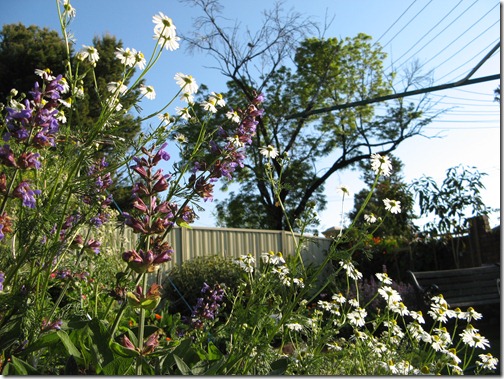
Flowering Herbs

Flowering Herbs

Californian Poppy

California Poppy

Cherry tomatoes

Cherry Tomatoes just about ready to plant out

Chicory

We love chicory

Sage and Oregano

Sage and Oregano

We have spent several enjoyable days working in our garden. The weather has been lovely and we have been able to make lots of mulch from our winter pruning's.

We have made a zucchini bed, a potato cage bed and a pumpkin patch. Our artichoke bed is looking good and we have lots of mulberries on our small trees.

The highlight of our garden is the herbs, rapa and rocket plants going to flower and forming seed.

We have planned our summer garden and we will are just hoping that we do not have heatwaves and that we can keep our garden healthy and productive. So for the moment we are dreaming of a mild Adelaide summer with tropical rain showers and cool nights. Reality will hit in January or even in November like last year.

Happy gardening to all.

Friday, 30 July 2010

TIME FOR THYME!

It is winter in Adelaide, it is cold and wet and lots of folks have coughs and colds, so it is time for thyme.

Thyme is a great addition to your medicinal herb garden.

Thyme contains thymol which you will find in toothpastes and throat gargles.

Thyme, honey and lemon make a great soothing mix to sip if you have a sore or dry throat.

Infuse some thyme in green tea, add a little honey and you have a great tasting herbal tea.

Thyme has great antiseptic properties as well as aiding digestion and boosting the immune system.

And thyme tastes great!

Combine thyme with other herbs such as sage and rosemary and the uses and health benefits of using these herbs is amazing.

Thyme is used in equal quantities with sumac to make Zatar which is used in Middle eastern cookery.

Thyme is used with cumin in Cajun cookery.

Thyme, parsley, bayleaf is tied in a bundle to make a bouquet garni which is then added to most French stocks and casseroles.

Thyme is a great herb to include in your cooked vegetable dishes, meat and fish casseroles, soups, baked goods, egg and cheese quiches, veggie and tofu burgers, salads and salad dressings.

In fact thyme goes with just about every ingredient I can think of that you have in the kitchen.

The many varieties of thyme enhance you food with different flavours.

We even add thyme, parsley, sage and oregano to our dogs raw food diet.

Herb Garden

Sunday, 30 May 2010

Be Nice to Nettles Week!

Did you know it is Be Nice to Nettles Week. Check out the website called Be Nice to Nettles Week.

Stinging Nettle

The picture above shows stinging nettle (Urtica Dioica).

Nettles play an important role in an organic garden. They are excellent added to a compost heap. They can be made into a liquid manure & used as an excellent tonic when sprayed on leaves & soil.

Nettles also have an important nutritional value as they are rich in vitamins A & C. The formic acid is destroyed by cooking so they can used in the same way as spinach. Use only the top fresh leaves. Nettles can also be made into teas, beers & wines.

Nettles are an excellent addition to cattle fodder & poultry feed as they are rich in chlorophyll, iron, nitrogen & calcium.

I hope you check out the Be Nice to Nettles website as it has some great information.

Friday, 12 February 2010

Comfrey and watercress and a cancer theory

HERBS ARE SPECIAL......


There is a lovely Australian website and blog for lovers of all things herbal. It is Isabell Shipard's Herbs Are Special. It explores every herb I have ever heard of and lots more, in depth, and son Hugh sent me a link to the page about comfrey, which has from time to time been given a rough trot. Maybe, like many another theory, comfrey is about to have its name cleared and become the latest wonder herb, as it once was. Being a lover of leaves and knowing how easy it is to grow comfrey I would love to start eating it too....well, actually I put it in last night's dinner. I know chooks love it and I have fed it to mine for years. It would be interesting to know what readers think.

....Read the book, ‘World without cancer, the story of vitamin B17’ by Edward Griffin, which reveals how science has been subverted to protect entrenched commercial and political interests. The book explores the revolutionary concept that cancer is a deficiency disease, the substance missing being B17 (also called laetrile), discovered by German chemist Leibig in1830, and further researched by Dr. Ernst Krebs and others.

Another Australian, who valued the HDRA research, was Foster Savage, who I mentioned earlier. I had the opportunity to know him, personally, when he settled in Nambour to farm (and later Cooroy); and, I knew you would guess, he grew lots of comfrey! Wilted comfrey was fed to his animals in large amounts. Why did he allow it to wilt? He told me that animals could eat much more, each day, when it was wilted! He often had groups and private people visit and he would, freely, share his knowledge of comfrey and how it benefited his land, animals and his family (note, he had 13 children). When legislation placed comfrey on the poisons schedule in Australia, and newspapers highlighted the ban, he wrote a letter to the Sunshine Coast Daily, in defense of comfrey, saying:

"I was perhaps responsible for 95% of the comfrey in Australia, having introduced the plant to this country in 1954, and having used the plant in great quantities, since then; I am, perhaps, competent to speak about it and to make a few comments on the …remarks about comfrey made by the CSIRO scientist …"To say that two leaves, eaten daily - over a couple of years - will cause serious disease, is simply not true. In our house, we have eaten 70 leaves, or thereabouts, daily, for 24 years: in the form of comfrey tea, liquidised in a vitamiser as a green drink, and in salads. I also fed comfrey to my farm animals.

Knowing the power of comfrey to restore a worn out animal quickly, and make her milk again, I once bought an old cow at the Dandenong Market, when farming in Victoria. It had been discarded by some farmer, as worn out. I put her on comfrey, giving her 90 lbs of wilted comfrey (wilted to increase the cow’s intake of comfrey’s extraordinary nutrients), and 90 lbs made a pretty big heap, about 4 feet high. This poor, old, creature took to the comfrey, without hesitation … she was starving for minerals and her instincts gave her a craving for comfrey. When she began to eat, she would eat off the heap of leaves for a couple of hours, then sit down for an hour or so. Later, she would continue eating, until every leaf was gone. If Dr. Culvenor’s words were true, imagine the poison she would be taking into her body, with this quantity of comfrey daily. If comfrey attacked the liver, then this cow would have died, because she was in a worn out condition. Instead, she doubled her milk output, within a week, and in a fortnight, trebled it. The remarkable thing, was that the cream that settled overnight, was some 3/4 inch thick and the separation of cream from the milk was so perfect, that the cream could be lifted off, with none remaining. I fed comfrey to calves, as much as they could eat, again with only gratifying results. I fed pigs, entirely on comfrey and grain, as much comfrey as they could eat, and the quality of those pigs was legendary, in the district.

The fame of comfrey spread far and wide, for my farm was visited by 6,000 farmers from around Australia and from overseas. Finally, I well remember the enthusiastic remarks of the butcher who regularly killed our comfrey-fed calves. He told us that he had never before, seen such healthy livers … that, mind you, after being reared on a herb that was supposed to cause liver diseases!"

 Watercress is one of my favourite salad additions and the information on this website about its properties makes me glad it is also very easy to grow in a tub of water. You can give it a haircut daily and it seems to grow back overnight in summer!

You can buy herbs, vegetables and fruit trees and seeds from them too....http://herbs-to-use.com/herbs-for-sale/trees-fruits-vegetables-legumes-rare-edibles.html. I will put their link in the side bar, under seed companies.

Picking Herbs To UseYou can visit the Shipard's Herb Farm, which is in Queensland:

139 Windsor Rd., Nambour.
(on right, past Sunshine Coast Institute of TAFE)

Open hours -
Monday, Tuesday, Thursday and Saturday - from 10:00am till 2:00pm.

If you would like to come at any other time, please phone during open hours a day or more in advance to confirm a time when you would like to visit.

Phone No. -
(07) 5441 1101

Fax No. -
(07) 5471 6430

email -
info@herbs-to-use.com

There are no blog entries after 2008..... shame... but you can subscribe to email updates from Isabell.

Tuesday, 2 February 2010

HOBART BOTANIC GARDENS... HOME OF PETE'S PATCH

I think I watched every episode of Gardening Australia while Peter Cundall was on it and I came to really like that pom enough to almost accept his advice. What I like most about him still is his determination to stop woodchipping Tasmania's old growth forests and to stand up and be arrested, at 82, for the cause. He also single-handedly brought organics into the homes of every Australian TV gardener, making purchasers of chemicals quiver in their boots, with his outspoken criticism of chemical agriculture and horticulture.

image

image Yesterday I visited the Royal Tasmanian Botanic Gardens, where Pete's Patch from Scratch began. Cleverly, placing this in a botanic gardens gives it credibility somehow and also ensures that it continues to inspire people long after Peter has left Gardening Australia and hopefully long after Gardening Australia has finished too. I knew I was approaching "his" vegetable garden because the use of vegetables as garden features seemed to have leaked out and spread into surrounding garden areas, as good ideas are wont to do. In this photo, left, of the conservatory garden, a narrow, stone wall raised bed is filled with silver beet (foreground) and each corner of the square is punctuated with a teepee of scarlet runner beans in their full flowering glory. Herbs and more vegetables form 90% of this entire beautiful garden, including the centrepieces of the 4 lawns filled with sweetcorn and rainbow chard (right).

image

image

The vegetable garden was of course lovely but what I loved most was the ecology of it all.... like I am always going on about.... surround your vegetables and fruit with herbs and flowers and native plants and you will gain on every level.... few pests, more variety to pick, whether food or flowers, and the sheer joy of seeing such abundance flourish so effortlessly as a result. And the earth will gain too, in too many ways to go into again here. There were bees and butterflies and birds and all things wise and wonderful in this beautiful border of herbs and perennials which formed the backdrop of the vegetable garden.


image

At the very back you can just see a corner of a massivimagee, old, brick wall which provides a much needed warmer microclimate for some of the fruit trees which are thriving here in less than ordinarily ideal conditions. There are citrus and tamarillos and passionfruit to name a few.

Scarlet runner beans grow to enormous heights here, as you can see in this photo and beans in general seem to produce incredible crops right through summer.

In the glass house were some tropical herbs like lemongrass.

All in all it was a wonderful, lush, productive garden full to overflowing with fruit and vegetables, all grown without chemicals of any sort.

"I guess that's your bloomin' lot".... as Peter would say .... "but you'll be absolutely blown away by the rest of the Botanic Garden that I will write about soon."

I will upload some more photos here soon. In the meantime, you can read about this beautiful garden here.

Friday, 19 December 2008

ANISE HYSSOP - AGASTACHE FOENICULUM

One of the best things about growing different vegetables and herbs for the first time are the surprises that await you as these tiny seeds or seedlings are placed in soil and tended occasionally and just left to grow and become what they are.

Our greatest surprise last summer was a herb we bought at the herb society last year.

The label said Agastache foeniculum, Tea Herb and Bee and bird attracting.
This one glorious plant attracted lots of bees to our garden and obviously the bees did there work in pollinating lots of other herbs and veggies in the garden.
We had an amazing amount of cucumbers.

I cut the plant back harshly and it died(or maybe it was my neighbours use of poisons on the fence line and his drive way).
This year we have not as many bees and less cucumbers.
This was a really majestic plant and I would recommend gardeners have a couple in their summer gardens.
These photos I took look a bit washed out compared to the real thing.
I have learnt another valuable lesson in loosing this plant, slow down in the garden take care of what you are growing and companion planting and bee attracting plants work.


The common name is Anise hyssop, a hardy perennial, grows to 2-3 ft (6ocm-1m), long spikes of purple- blue flowers. Grows in rich moist soil in a sunny position flowers in summer. Propagate in spring by seed or divide creeping root. Use dried leaves as a seasoning or infuse as a tea.

There is good information about herbal teas at this site The Herbal Tea Garden

If you want an adventure check out all you can do with garden herbs at Alchemy Works