Sunday, 1 February 2009

FROST, ICE AND TEMPEST

While you are all suffering with the shocking heat, I am here in southern France in winter. I wake each morning, throw open the shutters and see a field of white frost and often a cold mist hangs over the garden. Yesterday I went to empty the wheelbarrow into which I had put some soil from another part of the garden the day before. Something glistened and I thought it was odd that I hadn't noticed a sheet of glass in the wheelbarrow.... it was ice, of course!

image The day after I arrived, a tempest blew in from the west, shaking the trees, the roof, in fact the whole region, with winds in excess of 180km/hour! It blew for over 24 hours and cut all electricity and phone lines, killing 4 people. Trees were down everywhere, rooves were torn off and rivers flooded with the rain. We had no electricity for 6 days.... most of the local shops were shut, none could take credit cards but neither could the banks give out any cash, so getting anything at all was almost impossible. With no phones or mobile reception it was quite eerie and news only travelled in through visitors. Some places had no water either. Even the markets did not open as stall holders could not bake bread or or make other goods and some had so much damage their vegetable crops were destroyed. Here you can see Ian's pool shed blown over against the pool. Finally power was restored, the sun peeped out and people went out to assess the damage.

imageToday the thermometer hit 14C and I took off one of my many layers of clothes! Previously it has been between -2 and +6C.  We went to the Villereal market where most but not all of the producers had returned at least with some produce. There were some cardoons for sale today and also salsify, which I am unfamiliar with.

image


It was great to sit and watch the people, while having a noisette..... a short black coffee with a dash of hot milk.... my new flat white, and a chausson au pomme.... a kind of apple turnover with croissant-like pastry. Delicious! Next time I will take a photo.


image On the way home we called in to the tiny hill-top village of Eyenville, where the local source is situated. I love these springs in France, where water trickles from a rocky cave and people come to collect the purest water imaginable. This one happens to be set in paradise.....you can just see the little cave in the centreimage of the photo at left.


The reasons why I am here are complex. But for the moment lets just say I am a Hills and Plains Seedsaver staying in a Kitchen Garden in France and writing about life in rural France.

Friday, 30 January 2009

Veggie Wrap

This is how we keep our garden cool in the extreme heat of Adelaide’s summer.

Garden Wrap 001

The main garden bed protected from the vicious sun.

Garden Wrap 002

Herb garden.

Garden Wrap 023

Passion fruit & tomato shady area.

Garden Wrap 025

No scorching of the beautiful tomatoes. They are ripening very well.

Garden Wrap 026

Lemon Myrtle on the left also under shade cloth.

Garden Wrap 027

Curry leaf tree under shade.

Garden Wrap 029

All wrapped up for an extreme Adelaide summer.

A sunburned country

"I love a sunburned country
A land of sweeping plains
Of rugged mountain ranges
Of drought and flooding rain
I love her far horizons
I love her jeweled sea
Her beauty and her terror
‘Tis the wide brown land for me"
The Australian poet and writer Dorothea McKellar wrote her best-known poem 'My Country' at the age of 19 while homesick in England in 1908. The second stanza of this poem (above) is well-known to most Australians; the first stanza being about England is probably less well-known: -
"The love of field and coppice,
of green and shaded lanes
Of ordered woods and gardens
is running in your veins.
Strong love of grey-blue distance,
brown streams and soft, dim skies-
I know but cannot share it,
my love is otherwise."
OK, so blogs should have some poetry sometimes, but also a little irony: Veggie growers in sunburnt South Australia have been doing it tough this past week, and we're expecting another week of weather topping 40C (+104F) with no relief in sight.

Even keeping the water up to the garden is no longer enough; various fruits and vegetables are starting to suffer from sunburn and will have to be shaded to survive.

Perhaps Maggie is quite right to pick her tomatoes green and eat them now, before they are solar-roasted into oblivion...

At least the evenings are pleasant, with the planet Venus sitting up there tonight next to a new moon.

Thursday, 29 January 2009

FRIED GREEN TOMATOES

More Garden Produce 006  800x600

There are 2 kinds of fried green tomatoes in my kitchen at the moment.

The first are a few scorched green tomatoes from the 2 bushes we do not have shade cloth over. The dogs will eat these or I shall put them into some chutney I want to make.

The other kind of fried green tomatoes will be eaten by us.

Want my recipe, it is so easy.

Just slice some green tomatoes, coat them in seasoned besan (chickpea flour), cook them in a little olive oil until golden, turn them over cook until golden and soft in the middle. Serve with lemon or a fresh veggie salsa. Delicious.

Traditional recipes use wheat flour, the sliced tomatoes are dipped in beaten egg, then coated in flour but my recipe is quick and easy and I like the besan flavour.

So if you have some green tomatoes and some power, we have had a blackout the last 2 nights at meal times and one this afternoon as I write this, you might like to make up this delicious snack.

It is so hot outside you could probably even cook them in a cast iron pan in the sun!

Peaches and pumpkins

OK, that wasn't so bad!
Temperatures yesterday reached a new record high for the city of Adelaide, coming in at 45.7 Celsius (or just a tad over 114 Fahrenheit) and we should get that again today, according to the Bureau of Meteorology (known universally in Australia as the BoM). 'Very hot, dry and sunny' pretty-well sums up the weather for the next week...
All the lettuce seedlings are still battling on, and I have had to set the alarm for 6am to be up and getting water out before trundling off to work. One young chicken gasped it's last in the heat yesterday, but that wasn't any surprise, given that it's looked pretty weird ever since we bought it in as a day-old chick to get a broody hen off the nest by giving her a new interest in life.

Cherries, apricots and nectarines have disappeared from our daily breakfast table, as they generally crop coming into Christmas and for just a few weeks beyond. Luckily for us, the peaches and satsuma plums are just starting to ripen, and all these trees are bearing heavy loads. It's been raining lemons for three months now, and they are starting to wind up as well, dropping the very largest lemons as the crop comes to an end. Even the chooks - who spend the hottest part of the day under the lemon tree's deep shade - have picked up the rhythm of it. As soon as they hear the characteristic fluting sound of a lemon starting its downward rush through the upper foliage, they scatter to the winds to avoid the latest citrus-bombing organised by Mother Nature.

More than half of the vegetable garden is out of production this year, as we simply don't have enough water to keep it in action. The BoM are predicting above average rainfall for February, so we might get 12mm rather than 10mm, which would be a 20% improvement! Still, we are going to be ever-more reliant on a winter growing season here in Adelaide, when good water is assured and temperatures are still warm enough for brassicas and root vegetables.

And so I've been working on new ways to boost the water-holding capacity of the soil, and have been using deep trenches cut through thick compost layers to hold water for long-enough periods to push water well down into the root-zone when trickle-irrigating. This works because new compost is practically impervious to water when freshly-made from green wastes around the city. The pumpkins are over in the half of the garden that's out of action, with only climbing beans and asparagus for company. The compost acts as a deep mulch 300mm thick, and straw laid over that keeps the surface temperature down a bit so that the growing tendrils don't cook (the dark surface of the compost gets very hot in the sun).

Over in the background of the top photo one can see the giant heap of waste garden material I've yet to get around to shredding. Once that's done (while the weather is still dry) it will be spread on the paths to be further broken-down underfoot, while acting as a natural mulch to catch and hold in any summer rain that falls during thunder-storms.

And those brassica seedlings for the winter crop? I've planted the seeds along a drip-line that keeps a long thin seedbed active even through the hottest part of the day...the drip line is permanently connected to the rainwater tanks each afternoon while the rest of the watering system is dormant, keeping the surface moist enough for germination. That's it to the right of the evergreen shallots...

Tuesday, 27 January 2009

European wasps

Streuth! A gadget that really works!

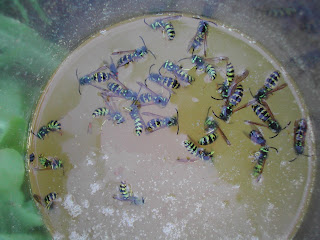
All those lettuce seedlings require daily watering, and all of a sudden this small patch of moist soil was attracting European wasps (also called German wasps, Vesbula germanica) - a recent introduction to Australian and a declared pest species. They'd land on the seedlings, and head down into the soil from there, so I suspected a nest was forming in the cool shade - surely the most pleasant spot on the property amidst the current heat wave (41 Celcius, 106 Fahrenheit, three days in a row!)
These wasps are certainly common in Germany, and hang about food, especially when picnics are underway. I've never been stung, but swatting at them drives the Germans into a frenzy, if not the wasps, although the latter are supposed to be particularly aggressive (shout the Germans in a frenzy) to whoever happens to be holding the tea-towel that just flicked at them.
I had David and Gill Corkill over for tea last week; David and I were both editors of The Living Soil magazine at different times. So I dug out all the old SASA back-issues of the magazine (which had mysteriously been left in my care) and gave them back to David who, unlike me, is a life member of the Soil Association of South Australia.
There, among all that old stuff, were some fly-traps. I've only had them unopened in the original boxes for five years, such being my lack of faith in garden gadgets, but the flies around the compost bins have been building up in this heat, so I pulled out these plastic thingies to put them to use. All one has to do is to take the bait powder (which smells like dried fish meal) and mix it with 500mL of water in the bottom of the jar. The flies crawl in through the inverted cone, but can't find their way out, leading to death by drowning.
In the first half-hour of deployment, I'd caught one European wasp, so I moved the trap up to the lettuce seedlings where those wasps were really buzzing about.
Next morning, 25 wasps, none still airborne, but only one Australian blow fly.
There's a moral to this little story; if only I could figure out what it is?

Sunday, 25 January 2009

A gift-wrapped garden...


BEFORE (showing trenches ready for seedlings)
And so, ‘lettuce see’ what it looks like next day (see the article 'Lettuce begin...' below), after pre-dawn watering and wrapping in shade-cloth, and with the Adelaide weather forecast being: -
Sunday Max 30
Monday Max 35
Tuesday Max 41
Wednesday Max 41
Thursday Max 41
Friday Max 39
Saturday Max 35
AFTER (showing shade-cloth in place)
Note the rain-water tanks in the background; two of these tanks also store the week's water ration. There are no pumps or water pressure systems; just hoses and buckets.

Watering requires patience, but such slow furrow irrigation (with the orange flooder on the end of ordinary hose connected to the tanks, shown in the pumpkin patch) soaks in well, allowing the soil to act as a water store until the week's water ration arrives on Sunday and Wednesday between 6.30am and 9.30am. The dark soil is actually compost laid over clay. It won't contribute much to soil fertility until after the next winter rains have broken it down and earthworms have incorporated it into the soil. But it makes an excellent mulch. Water spreads out underneath it, and plant roots follow.
Some folks put all their spare cash into their superannuation funds. I'm putting mine into compost (purchased by the truckload) and soil fertility and better soil water-holding capacity.
After all, you can't eat money, it will get hotter, and water will become scarcer.
So gardening under these conditions is excellent practice for a drier future.