Friday, 13 March 2009

Bill, Basil and Bees

DSCN0002 It’s ‘bee tax’ time!

Bill Hankin came around last night to sit on the porch at sunset with us (after the obligatory garden tour) and to drink red wine with pesto on brown bread, various cheeses and late-season grapes.

Bill’s a real organic farmer, as distinct DSCN0005 from your regular backyard seed-saver like me, managing a big organic property called BioPark up in Mount Barker. We’ll hear more from Bill in the next month, as I do some ghost-writing for him about his environmentally-friendly farming methods.

Bill asked why we hadn’t taken to the hedge-shears to the basil, which is flowering wildly as it runs to seed; cutting off the flower heads prolongs the picking season, and the accompanying luxury of basil pesto on our bread. (‘Pesto’ is basil leaves, rocket, almonds, olive oil, herb salt and garlic ground into a paste and covered with more olive oil in a dish to prevent it oxidising.)

DSCN0015 And so I explained ‘bee tax’; during autumn each year I feed up the bees in grateful thanks for all the good work they’ve done for me this past growing season, pollinating all the veggies, particularly the pumpkins and zucchinis. (Bill’s looking a bit askance at the pumpkin patch here – I guess it seemed a bit mundane after I’d explained the wonders of my ‘super cloche’ - behind him - used to keep birds off the chard and silverbeet seedlings. It’s made of high-pressure gas pipe that I found beside the road…)DSCN0007

So here they are, the friendly little fellows, enjoying the flowers of the ‘common mint’…

Monday, 9 March 2009

GROWING LUFFA GOURDS

Luffa #4 [This article on luffa gourds appeared in The Living Soil – the Journal of the Soil Association of South Australia – in January 1985, written by Merrill Gilfillan. As the TLS editor for some years, I was at the helm during the SASA 30th anniversary in 2005, and delivered three lectures which dug up all sorts of interesting facts  for the gardener from back-issues of the Journal. This one set me on the path of growing and saving the seed of this interesting vegetable. While much is written on the use of these ‘vegetable sponges’, one should not overlook the young trellis-grown fruit, which taste something like a cucumber crossed with a zucchini. Besides, they’re good fun to show off to visitors to the garden. I have plenty of seeds for South Australians who’d like some.  It grows well here. The photos I found on the web though Google Images/Luffa; my thanks to the seed companies who provided them.  Andrew]

luffabloom The luffa, also known as the dishcloth gourd or vegetable sponge, belongs to the Cucurbitaceae family. It is native to tropical and warm temperate areas. Only two of the several species are of common economic importance - Luffa cylindrica, the most valuable, and Luffa acutangula.

The luffas are rank-growing vines with lobed leaves and tendrils. The flowers are yellow and the stamens and pistils are on separate flowers. The fruits of L. cylindrica are green, smooth and elongate, suggesting a cucumber, and they grow to two feet in length and five pounds in weight.  The fruits of L. acutangula have ten sharp ribs or flanges-running length-wise.

The net-like fibrous skeleton of the gourd is the remarkable feature of luffas and one which gives them economic importance. When the fruit is ripe, the outer wall may readily be removed leaving only the compact, fibrous network; the luffa of commerce. In the core of the net, each seed is held in a pocket. The tip of the fruit comes off as a small lid at maturity, and the seeds gradually loosen and may be shaken out through the hole.

USES


luffa #5The luffa sponge network has a number of advantages over other fibrous materials which gives it economic value. Its strands form a compact network and thus makes a continuous structure. This has a large internal surface which holds water well, and so is well adapted for washing dishes, glasses and narrow jars, and for cleaning forks by thrusting them into the net. It is very resistant to wear and can be used for scouring and rubbing down painted surfaces. Luffas are used as bath sponges, especially in England. The fibre is resilient and is used for shock absorbers, table mats, packing material and stuffing material for pillows, mattresses and saddles. Also as a heat insulator in tropical helmets. The young fruits can be eaten, and the sap of the vine is believed by the Japanese to have medicinal properties. An important economic use has been as oil filters in steam ships. Thus it can be seen that the luffa deserves a place in the garden of all those people who aim to be self-reliant.

Sponges are prepared by placing the fruits when ripe in water until the outer wall disintegrates and can be removed by rubbing or brushing. Expose the clean sponges to sun and air to dry and bleach. The seeds should be removed and saved for next season, prior to curing.

CULTIVATION


Luffas are sensitive to cold and the seed should be sown only after the ground is thoroughly warm in spring. They require a 140 day growing period. Be patient if the seeds are slow to sprout, that is a characteristic of luffas. They require full sun, and soil that is rich and organic. Plant 3 or 4 seeds to a hill, ½ inch deep, with the hills 4 to 6 feet apart. (Please excuse imperial measurements). For greater production and healthier plants, place a shovelful of rotted manure or compost in a hole below the mound.
For best results in obtaining superior quality luffas, the plants should be grown up a trellis or wire fence so that the fruit does not touch the soil. If they must be on the soil, mulch well and hand turn the luffas to obtain uniform growth. More plants can be grown using this method of trellising and therefore is useful in small gardens.

Luffa #1 Luffas require plenty of moisture during the growing season, so water in dry spells if possible. Better quality luffas can be grown by removing all the first flowers that appear on the plants, as well as fruit that is poorly shaped or diseased.

Controlled pollination is very easy as with most cucurbits, since staminate and pistillate flowers are separate. In the late afternoon it is possible to determine which flower buds will open the next morning, for the tips of these begin to turn yellow. If the tips are tied up at that time with a loop of soft cotton string, the flowers cannot open and bees are thus prevented from entering them. On the following morning, pollen can readily be transferred to the stigmas of pistillate flowers. The latter should then be bagged for a few days until the stigma dries.

Each vine should produce 20 - 25 gourds.

Wednesday, 4 March 2009

Big bananas and pico-peaches

"The best fertilizer is the gardener's shadow"

I must note (with some sense of sadness) that the water restrictions and recent heat waves have seen many once-productive Adelaide gardens abandoned during this past summer. DSCN0012

One chap who comes to mind retired last July and did a nice job during spring of building up his veggie patch, with some fine tomatoes and cucumbers, basil and carrots. Come the first heat wave, he threw up his hands and went inside to watch the cricket and to moan about the water restrictions, leaving the garden and all potential crops to whither and die. I've met many folk recently who sing the same refrain: "too hard, too hard..."

How can we save seed, reduce our personal footprints and learn to live in an altered climate if our best gardeners spit-the-dummy when the chips are down?  DSCN0010Who will be left to lead the way and retain that knowledge of local plants suitable to our local conditions? Who'll be around to pass on advice to folk new to growing their own food?

  OK, so I'm not blameless either in these hard times; I stayed out the backyard with the veggies and pretty-much left the fruit trees in the front yard to their own devices. And therein lie some valuable lessons...

1) Bananas: We have a small grove of "Lady Finger" bananas that somehow survived the heat and the fact that I cut their water ration to zero. I'd also cut out all the old palms last year to allow the light into our north-facing sunroom. The young palms that sprang up produced some sizable hands of bananas. So I will keep thinning out the old ones and enjoying bananas.

DSCN00152) Peaches: Peaches ran riot in the hot weather, on no water. We has three full boxes over the past six weeks, and didn't manage to eat them all - many just dropped to the ground to rot.

The last ones (from the fridge) were eaten last week, and the very next day, almost miraculously, the late-season cling-stone peaches were ready (photo). They are very small this year (for lack of water during the cell-division stage of setting the fruit), but they are abundant and delicious - like peach-flavoured  apricots. And coming up after them is another tree loaded up with another variety of cling-stone peach, covered in much bigger fruit. So peaches for another month, then the citrus will be back...

So perhaps the closing message should be this: -

"When the going gets tough, the tough get going!"

DSCN0008And P.S. It’s raining for the first time in over two months! 18 mm today.

Tuesday, 3 March 2009

NIRVANA EVENTS

Now is the best time to start, review ar renew your vegetable garden to ensure future harvests. A great way to get inspiration on how to go about it is to spend some time with Deb at Nirvana Organic Farm
ORGANIC VEGETABLES FOR YOUR TABLE ALL YEAR.
SUNDAY, MARCH 8TH 9 am - 12.30 pm $40

The craft of composting is essential to master for all gardeners. There is much talk about compost, mulch but how much do you realy know about the differences, process or stages of development? What materials can you use and which methods are best for me? Come and find out.
COMPOST AND MULCHING
SUNDAY, MARCH 15th 9am- 12.30 pm $40

For those who want to delve a little deeper or interested in quality then the biodynamic methods of gardening may inspire you and aid your garden by developing quality humus along with strong plants that aid in reducing water needs and when the rains come your garden quickly bounces back.
BIO-DYNAMIC GARDENING - Beyond Organics
SUNDAY, MARCH 22nd 8.30am- 4.30pm $100 Includes lunch, notes & 12 months biodynamic membership .
TO BOOK IN TO ANY OF THE ABOVE CALL DEB or QUENTIN 8339 2519

WHAT'S A HOME GARDEN WORTH?

The latest Kitchen Gardeners International newsletter begins with this piece by Roger Doiron. I stayed with Roger's family in October and one morning I dug and trimmed those endives he has now harvested and mentioned in this article. I also experienced the weighing of every single thing that was harvested from the garden while I was there. It was an onerous task but now it is interesting to see the results. If you also have fruit trees in your garden, you can add hundreds of dollars to the "worth" of your produce. You can then use the money saved to buy feral meat or a rain water tank or some insulation or something to make you less reliant on fossil fuels etc. Or you could give to the needy or to an environmental project. Or maybe save it for a rainy day..... or a very dry one.
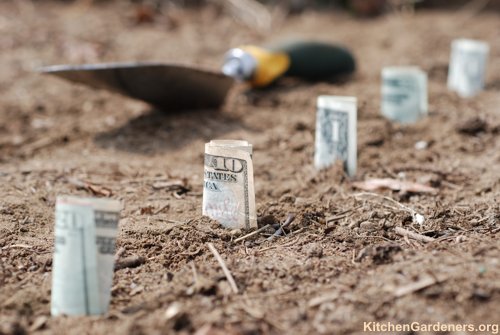
What’s a home garden worth? With the global economy spiraling downward and Mother Nature preparing to reach upward, it’s a good question to ask and a good time to ask it.
There isn’t one right answer, of course, but I’ll give you mine: $2149.15. Last year, my wife Jacqueline suggested to me that we calculate the total value of the produce coming out of our garden over the course of the growing season. Initially, the thought of doing that was about as appealing to me as a recreational root canal. I remember replying something like: “OK, so let me get this right: in addition to raising three busy boys, managing two careers, volunteering in a school garden, and growing most of our own produce, you’re proposing that we weigh every item that comes out of our garden, write it down in a log book, and spend a few leisurely evenings doing math?” Jacqueline, an economics major in college and a native French speaker, answered with a simple "oui" and so the project began.

There was a lot of work involved, mostly for Jacqueline, but as with gardening itself, it was work with a purpose. It didn’t take long for our log book to start filling up with dates and figures. Although we started eating our first garden salads in late April, we only began recording our harvests as of May 10th, starting first with greens and asparagus. Our last weighable harvest was two weeks ago in the form of a final cutting of Belgian endives forced from roots in our basement.
By the time we had finished weighing it all, we had grown 834 pounds and over six months worth of organic food (we’re still eating our own winter squash, onions, garlic, and frozen items like strawberries, green beans, and pesto cubes). Once we had the weights of the 35 main crops we grew, we then calculated what it would have cost us to buy the same items using three different sets of prices: conventional grocery store, farmers’ market and organic grocery store (Whole Foods, in our case). The total value came to $2196.50, $2431.15, and $2548.93 respectively. For the other economics majors and number crunchers among you,
you can see our crunchy, raw data here.
There are things we didn’t include like the wild dandelion greens which we reaped but did not sow, the six or so carving pumpkins which we ultimately fed to our compost pile, and the countless snacks of strawberries, beans, peas, and tomatoes that never made it as far as our kitchen scale. There were also things we forgot to weigh like several pounds of grapes which turned into about 12 jars of jam. As with any growing season, there were hits and misses. The heaviest and most valuable crop was our tomatoes (158 lb/72 kg for a total value of $524). In terms of misses, our apple tree decided to take the year off and very few of our onions started from seed made it requiring me to buy some onion plants.


On the cost side, we had $130 for seeds and supplies, $12 for a soil test, and exceptional costs of $100 for some locally-made organic compost we bought for our “

This Lawn is Your Lawn” frontyard garden (normally, we meet most of our soil fertility needs through our own composting). I don't have a scientific calculation for water costs, but we don't need to water much and, when we do, water is relatively cheap in Maine. Also, I mulch my beds pretty heavily to keep moisture in and weeds down.  Let's say $40 in water.  So, if we consider that our out-of-pocket costs were $282 and the total value generated was $2431, that means we had a return on investment of 862%. The cost of our labor is not included because we enjoy gardening and the physical work involved. If I am to include my labor costs, I feel I should also include the gym membership fees, country club dues, or doctors’ bills I didn’t have.


If you really want to play around with the data, you can calculate how much a home garden like ours produces on a per acre basis. If you use the $2400 figure and consider that our garden is roughly 1/25th of an acre, it means that home gardens like ours can gross $60,000/acre. You can also calculate it on a square foot basis which in our case works out to be roughly $1.50/ft2. That would mean that a smaller garden of say 400ft2 would produce $600 of produce. Keep in mind that these are averages and that certain crops are more profitable and space efficient than others. A small garden planted primarily with salad greens and trellised tomatoes, for example, is going to produce more economic value per square foot more than one planted with potatoes and squash. We plant a bit of everything because that’s the way we like to garden and eat.


Clearly, this data is just for one family (of five), one yard (.3 acre), one garden (roughly 1600 square feet), and one climate (Maine, zone 5b/6), but it gives you some sense of what’s possible. If you consider that there are about 90 million households in the US that have some sort of yard, factor in the thousands of new community and school gardens we could be planting, this really could add up. Our savings allowed us to do different things including investing in some weatherization work for our house last fall that is making us a greener household in another way. Some might ask what this would mean for farmers to have more people growing their own food. The local farmers I know welcome it because they correctly believe that the more people discover what fresh, real food tastes like, the more they'll want to taste. In our case, part of our savings helped us to buy better quality, sustainably-raised meat from a local CSA farmer.
The economics of home gardening may not be enough to convince President Obama or UK Prime Minister Gordon Brown to plant new gardens

at the White House or 10 Downing Street, but the healthy savings their citizens could be making and then reinvesting in their local economies could.

In the end, it might come down to the language we use. Instead of saying "Honey, I'm going out to the garden to turn the compost pile", perhaps we should say "Honey, I'm going outside to do a 'green job' and work on our 'organic stimulus package.'”  I bet that would get the attention of a few economists, not mention a few psychologists!

Happy, healthy March,

Roger Doiron

Saturday, 28 February 2009

THE AFTERMATH OF THE TEMPEST

image We went for a drive to Arcachon which is on the Atlantic coast,  2 hours southwest-ish of Bergerac, south-west France. It was a beautiful sunny day for a picnic and a walk on the beach. The tempest or hurricane that lashed south west France a few weeks ago had come in from the Atlantic at about this position on the coast and the devastation is everywhere still. Whole forests of large pine trees are lying broken in half or ripped from the ground, leaving a few lonely specimens to show what was previously hundreds of mature trees. image

All along the roads and in people's yards and on every piece of vacant land now stand piles of logs, ranging from over half a metre across, down to kindling size.


These major roads were closed for days because so many trees had fallen across them and many now lie alongside the road, awaiting the chainsaws.

In the photo below there are many rootballs of fallen trees, as far as the eye can see, and not much else.
image
   image


Tears of sap.


Near Arcachon is the tallest sandhill in Europe, La Dune de Pilat, at over 100m high and 3km long.image And along the coast are miles of beautiful, white beaches.


Those who were not out dealing with timber today, were preparing the soil in their vegetable gardens for the new season. What a place France is for growing food! Everywhere, people were outside enjoying the sunshine and working in their plots. Many are warming the soil with small, plastic cloches. Some are hoeing weeds or preparing seedling beds. What a sight all they will be in a couple of months, full of tomatoes, capsicums, lettuce etc for the enjoyment of a great percentage of the families of rural France.

Thursday, 26 February 2009

Summer ends, and harvesting begins

DSCN0008For those of us in Adelaide who’ve continued to grow our own fruit and vegetables through heat, dust, drought and water restrictions, the prospect of summer’s end in a few days time holds out the promise of golden sunny days and cooler mornings and evenings. Maybe even rain? The winds drop too in autumn in South Australia, and it’s time to take stock of the past growing season as harvest begins in earnest.

DSCN0023 Things are a bit sad around my household, because Claudia’s mum in Germany suffered a stroke a few weeks back, followed by all sorts of complications. So it’s just myself and my three sons around the kitchen table while Claudia is over in Europe at her mother’s bedside as mum recovers slowly.

Fortunately for me, my three sons can all cook, and I can clean, garden, feed chickens and make salads and everyday meals, so we’re getting by. But what I really miss around here is the sight of the cook herself browsing through the garden, picking whatever’s fresh for our evening meal together, and offering a quiet word of encouragement to theDSCN0009 gardener humping water on his lonely rounds.

So with your forbearance, and a little help from my friend Roger, here’s the state of play in the veggie patch; all to bring a touch of home to loved one’s in Europe.

And PS: I was supposed to appear in these photos… But Roger is as fit as the proverbial “Mallee Bull”, and looks much better draped over things than I do, so he gets the starring role. He’s a darn sight smarter than I am too, but you can’t see that in the photos.

DSCN0014 DSCN0024

DSCN0025 DSCN0015 DSCN0004   DSCN0006

DSCN0022 DSCN0013

 DSCN0001 DSCN0007