Showing posts sorted by relevance for query sauerkraut. Sort by date Show all posts

Monday, 7 September 2009

Making sauerkraut

The Roman emperor Tiberius always carried a barrel of sauerkraut (lacto-fermented cabbage) with him during his long voyages to the Middle East because the Romans knew that the lactic acid it contained protected them from intestinal infections. In ancient Rome, sauerkraut had a reputation as a food that was easy to digest. In China, they fermented cabbage 6000 year ago… [from the book ‘Nourishing Traditions’ by Sally Fallon, page 92..93]. Sauerkraut is also an excellent source of Vitamin C, and so was carried on board sailing ships once the link between the disease ‘scurvy’ and lack of Vitamin C was established as the cause of teeth-loss and declining health of sailors on long sea voyages.

Somewhat more recently, my wife’s relatives in Germany stored cabbage for the long cold winter months by making sauerkraut and storing it in the cellars beneath their homes in the village. The particular large conical cabbages they use are unknown here in South Australia, but are commonly available from gardening shops in Germany, from whence my small store of seed came.

These cabbages grow to over a metre in diameter, and the cabbage head can weigh many kilograms. If left too long in the garden, they also fill up with slugs and earwigs or bolt to seed as Spring brings warmth to the soil.

DSCN0005Making sauerkraut is labour-intensive, as the cabbage must be cored, washed, shredded, mixed with whey, sea-salt and caraway seeds then pounded with a wooden pounder to release the juices. It is then pressed tightly into wide-mouthed jars with the wooden pounder until within 25 mm of the top of the jar then covered tightly and kept at room-temperature for three days. It may be eaten immediately but improves with age.

DSCN0009 DSCN0011

We don’t have a cellar to keep things cool, but we did pay a chap $200 to cut a trap-door into the floor space on the cooler southern side of the house through our wooden floor; we keep the finished sauerkraut down there between the foundation piers.(Also stored down there are rice, sultanas, grains, olives and other lacto-fermented vegetables and meats that we are still experimenting with…)

It’s also a handy spot to store very large cooking pots that don’t fit into the kitchen cupboards.

DSCN0012 DSCN0014

Sunday, 5 June 2011

If only every Suburb had a Community Garden and a Kitchen Gardeners Swap Meet.

Batty's Garden-8Allie & Steve's Visit-146
Many people today are striving hard to fit into today's culture.
Many of us vegetable gardeners feel a little out of place at social gatherings. We would much prefer to be in our gardens, pruning, planting, weeding, picking or preserving our produce.
Our to do list is endless, sorting seeds, making sauerkraut, pickling olives, transplanting seedlings, propagating cuttings and there is always pruning to be done.
I meet very few gardeners who are not keen to talk about what they have been growing or how the weather is affecting their garden.
So we have this group of home gardeners who meet together every few months and we always have a good time.
When we meet to swap seeds, excess produce and ideas, we also share part of our lives with each other.
We may meet for just a couple of hours but friendships are formed, phone numbers exchanged and the promises are made to share produce as it ripens and matures.
Someone has chokos to share, someone else has excess chillies, another has apples and firewood, the list goes on and on.
Cuttings and prunings, excess seedlings, potted plants are brought and given away.
Cuttings of herbs, curry leaves and berries, ginger, galangal, lemongrass and cardamom plants are divided and shared.
Variety is being added to people's gardens, new plants and ideas are being introduced.
People are taking things home to grow, things they had never heard about before. New flavours are introduced and as people try new things and use them at home, their palates change and they look forward to trying new and interesting plants.
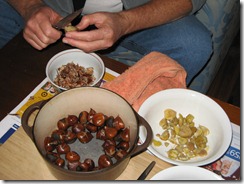
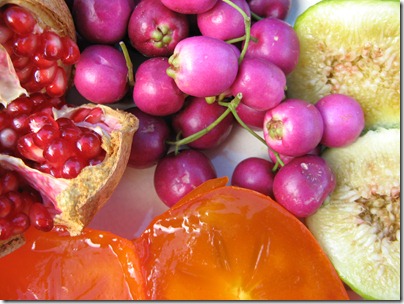
Chesnuts-2Beef, Beans & Basil-7Curry Leaf Tree-2
And so for a few short hours people are introduced to new things, new ideas and new challenges.
If we lived in any rural area in any other country it would be a natural thing to save seeds and share with neighbours. But in Australia the majority of people are buying their fruit and veggies from large supermarkets or fruit stores. These unknown, mass farms are often using many harmful chemical sprays and fertilizers to achieve a perfect looking product, which looks good but lacks the flavour and nutritional value of organically grown produce.
Our priorities in life should be healthy pure rain water, fresh clean air, viable seed, local, organically grown food and a healthy lifestyle.
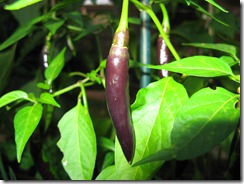
Lasagne-1Seedlings & Purple Chilli-3Brown Rice, Besan & Chive Cakes
A lifestyle which includes rest and relaxation, time to spend with others, time to share a simple meal or wander around a friend's garden.
When you live in a city you see people constantly rushing around, driving children from one paid activity to another. Children who have been in child care all day are seen throwing tantrums in shopping malls and supermarkets as their hassled parents fill supermarket trollies with chemical laden foods, coloured beverages and other sugar laden sauces, cereals, sweets and cookies.
I guess I am just getting to be a grumpy old granny, but to those of us who grew up in the forties or fifties we remember a much different world.
Seedsaver Maggie-20Seedsaver Maggie-5Colours of Autumn-14
Most families grew their own vegetables, had chickens for eggs and chicken for a special occasion.
There was no television, people sat and chatted about their day, listened to the radio or read books, played cards or board games.
All the neighbourhood children played cricket on the road, there were fewer cars and people rode their bikes, walked or caught public transport.
Anyone remember going to work in an old steam train?
I did. I caught the train from Liverpool Station to Central station in Sydney. A group of us teenagers met in the same compartment each day and played cards or just chatted.
Now the people I see walking the streets are plugged into their  iphones or ipods and don't even look at anyone.
Time is money now, so people rush everywhere, drive like maniacs and have no concern for anyone but themselves.
So it is with great pleasure that I look forward to when our garden group meets again.
Our dream would be for every suburb to have a Community Garden and every Community Garden to have such groups meeting several times a year.
   Seedlings & Purple Chilli-1Colours of Autumn-7

Sunday, 23 August 2009

Start-of-Spring Seed-Swapping Sunday for Seed-Savers…


What more pleasant way to spend a Sunday afternoon during the last days of Winter than swapping seeds with like-minded folk in the pleasant straw-bale building at the Fern Avenue Community Gardens?

DSCN0093DSCN0095 The Hills-and-Plains Seed Savers are united in a common love of backyard gardens, and we save and pass along (at these swap meetings) rare vegetable seeds and tips on what grows well or not in the Adelaide Hills or down here on the Adelaide Plains.DSCN0056

We have no committee or formal structure but prefer to meet informally. So we sit around and take it in turns to introduce our seeds and gardening experiences. When all that’s over, we like to stand around and sit around some more, eating the goodies that the cooks among us have brought along.

DSCN0089

Deb talked about humus and good compost and how important a living soil is to the production of good food, and had some great hand-outs for us on perennial nettles and organic gardening.

DSCN0071

Bob had brought along Kate’s remnant seed-collection to be distributed amongst us, plus a bag of water-chestnuts to propagate.

‘Veggie Gnome’ and ‘Flower Gnome’ had a nice collection of seeds, berries and bulbs, including Jerusalem artichokes. The latter are famous for the after-blast, but Maggie had brought along something called Epazote which the Mexicans eat with beans to prevent the same after-meal trumpet concertos.DSCN0066

Barb had some rare and wondrous tomatoes already coming along in pots. Andrew had weird pumpkins plus German sauerkraut cabbage seeds and German ‘Lazy Wife’ beans, plus all sorts of chillies.

DSCN0067

Sixteen-year old Daniel stumped us all with a question about aphids on garlic, which Deb explained was due to a soil imbalance causing the garlic to produce the wrong-type of sugars – those that aphids and their farmer-ants love.

And we all came home richer in friendship and knowledge plus seeds and seedlings…

DSCN0070

DSCN0068 DSCN0069