The second great Food Gardener’s Forum was held on 02/12/09 at Fern Ave. Community Garden in Fullarton.
We enjoyed a beautiful Adelaide day sitting in the garden under the shade of the lovely old elm tree. Guest chooks clucking, the rooster crowing, children playing happily and other gardeners tending their plots. And so we present to you "Meg's notes from under the elm tree."
Here is what Meg wrote:
Three inspiring speakers addressed the audience assembled under the elm tree. In perfect weather conditions, surrounded by productive gardens and serenaded by clucking chooks, we listened intently to the stories being shared. From Morag Bain on keeping chooks, and Dr David Harrison on fruit tree growing in Adelaide, to Dr Pam White motivating the young and old alike to the value of garden produce.
The Forum was the inspiration of Diana Bickford and Cath Caon who recognized a need in the gardening community for sharing the knowledge and wisdom of experienced local food producers.
Diana is planning to have seasonal Forums.Thanks go to Diana, the 3 Speakers, Chris Meehan for helping to transport the chooks and Cath Caon for their organizational help and setting up, and to the audience.


Morag Bain and her helper Chris Meehan
Morag, a Permaculture enthusiast, has kept chooks for the last 6 years, and feels they have significantly contributed to her current well being and good health. She works full-time, but considers herself a micro mini farmer and processes surplus roosters; a task she estimates takes her an hour per bird. Araucana bantams have a gentle nature and lay small green/blue eggs, but Morag has crossed them with other chook breeds to increase the egg size. Isa Brown chooks may only last 18 months, but by crossing them with Araucana Bantams they have a longer laying life
Her 2 roosters have had their wings clipped to prevent them from roosting in trees where it is difficult to get them down when they start crowing at 2.00am!
She finds an incubator is more reliable for raising chooks than leaving it to the hens, as Isa Browns and Rhode Island Reds are hopeless mums. She did bring along a broody hen comfortably enthroned on about 10 eggs in a nest of shredded paper conveniently made in a lawn mower catcher – a very easy and balanced carrying arrangement, and there was no problem with her wanting to escape as she remained committed to sitting on her eggs. Meanwhile her travel companions, a rooster and a hen called “CD”, noisily protested their lack of freedom to explore Fern Ave. Community Garden. Morag demonstrated picking them up and supporting their chest, and then showed us how to calm a flapping chook by stroking its chest against the feathers, or, to get the same effect, by holding the chook upside down by the feet, and running its chest against your leg from your ankle to your thigh.
Morag keeps her chooks in an area about the size of 2 tennis courts. She says you can do anything with them at night. You can put newly hatched chicks under a hen at night and she will accept them as her own, but put them together during the day and the hen will reject them.
Morag sprinkles sifted ash from a wood fire around the dry area where the chooks dust themselves to reduce any scaly feet problems. She has used “Pestene”, but prefers not to, as commercial products have warnings including about keeping it out of the birds and your own eyes.
She recommends keeping their food area covered with wire to prevent visiting pigeons coming in and bringing diseases and infections such as red mite. She only feeds her chooks kitchen scraps that are just borderline for human consumption, if they are really off, they go to the worm farm. Rather than feed the chooks pellets, she feeds them a handful of mixed grains daily from the “Barastoc” or the “Red Hen” product range. It is essential they also have enough water, and somewhere to scratch. Never give chooks a whole egg shell, or it will start eating its own eggs, but you can give them finely crushed egg shell for grit. She recommends going to the Mt Barker Fodder store which also has a good range of chock breeds.

In her Council area chook houses have to have cement floors, and Morag puts bedding straw on top rather than saw dust as it is windy up in the Adelaide Hills. As the chook manure is so strong, she puts the sweepings of straw and manure to soak in water, and after it has steeped a while, dilutes the liquid and uses this on the garden. Her hens all seem to want the same perch and crowd on top of each other, but noticing that chooks that perch the highest tend to survive fox attacks, she has provided high perches and facilitates access with a ladder.
If you have had a rooster with the hens for 2 weeks, you can assume the eggs will be fertile. At 10 days you can candle the eggs, and if you can see a black speck, the eggs are fertile. To check if eggs are fresh, see if they lie flat in water, if they float on top they are only fit for the compost heap. Apparently for every day an egg is kept out of the fridge, it loses a week of freshness.
Morag’s chooks lay about 265 days a year. From her experience, she says it can take 22-26 weeks, rather than 18-20 weeks, for a chook to start laying, and if they are born in late Spring, the 22- 26 weeks takes you up to winter when they don’t lay anyway, so it may be a year before they lay!
You need to keep a minimum of 3 chooks, and one of them will always get picked on by the others. If you want to introduce new chooks to the flock, do it at night, when you can do anything with them.
Dr David Harrison

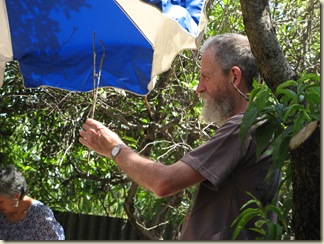
A recently retired vet, Harry is the President of the South Australian Rare Fruit Society. He regards Adelaide as the ideal place to grow summer fruits because the dry summers prevent many of the problems faced in warm moist Eastern Australia. Also, fruit trees are more efficient users of water than vegetables, so we should concentrate on growing fruit in our hot summers. Harry reckons stone fruit (apricots, nectarines, peaches, plums and almonds) and pome fruit (apples, pears, nashis and quinces) get on ok with less water than you think. Apricot trees especially will do well with no pruning, no fertilizer and no watering. Fig trees, however, like lots of water.
While the average rainfall of Adelaide is 450mls, if you stop all the rain that falls on your home buildings from going into the storm water, you in effect end up doubling the rain water available to the garden.
Using the definition that a weed is a plant that is out of place, Harry regards gum trees as weeds in the garden as they take up too much moisture, and unless mature, do not even offer the benefit of hollows for wildlife. Instead of a gum tree, he recommends Biodiverse native planting such as you see along Windsor Avenue near Fern Ave. Community Garden.
Apricots, and to a lesser extent plums and almonds can handle the hot western sun in summer in Adelaide, but peaches and nectarines are less tolerant. Pome fruits do not handle the hot west sun and should be planted on the south side of buildings, and not where they are exposed to radiated heat from a brick wall. They need a chill factor, and as air flows like water, you can plant Pome trees in a slight hollow, so the cool air sinks in there. By contrast, plant bananas on slightly raised ground which is sloping, so any frost or cold air can flow down the slope and away from the banana.
Harry stressed the importance of the first foot or 30cm of soil for trees. Clay ground should have 5-7cm (2-3 inches) of course sand added, while sandy ground should have 5-7cm (2-3 inches) of clay added, and both need organic material. Before planting, dig a hole and fill it with water to see how it drains. If it takes half a day to drain, it is ok. If it doesn’t drain that well, it could be the ground has been compacted by heavy machinery or animals. In that case use a crowbar to dig down 60-90cm (2-3 feet) and mix in some course sand. Organic material should only be added to the top 15cm (6 inches) of soil, because if it is added deeper than this it will be broken down anaerobic ally (without air), and this is bad for the roots.
The best way to add compost is to just put it on the ground and then cover it with mulch such as pea straw to protect it. Depending how it is made, compost should supply phosphorus, potash and nitrogen. Compost made with a lot of newspaper will have less phosphorus than compost made with chicken manure. Low phosphorus compost is still good to use, as it will still promote beneficial microbial life in the soil, and feed the tree and protect it from less desirable microbes. Pea straw provides no nutrient to the tree because all the goodness goes into the pea, but the straw does provides carbohydrate for the tree, and it needs that to replace the carbohydrates lost in nectar. Spread 5-7 cm (2-3 inches) of compost 2-3 times during the growing season and always cover with loose mulch because compost should never be exposed to sunlight, and mulch on top helps to keep the moisture in and protect the microbes and bugs. Just digging into soil causes carbon and nitrogen to evaporate into the atmosphere.
Harry explained how large scale Agriculture operates like hydroponics, so much of the research and the products designed for use there are not appropriate to the backyard gardener. He has used the granite dusts from Fisher’s Creek in Central Qld., and All Rock from Southern Qld., and he mentioned a new paramagnetic product from Mt Shank near Mt Gambier in South East S.A. which scientists are claiming improves the soil biology but can’t explain why. Harry feels by getting the bugs right, the goodness locked in the soil, wherever it comes from, can be released and used by the plants. As for fertilizer, Harry said it should only be added if the soil itself looks good and if it has a nice rich layer. 80% of the trees feeding is from that first foot of soil, and this is also where oxygen is available. Harry suggested if you do want to grow plants such as lettuce, in summer, in the shade of your fruit trees, you should plant them in raised planting boxes.
He also recommended “Nibble” pruning which can be done each season, and it doesn’t need to be a lot, but is better than not pruning. He also mentioned that it is in winter that you can move and manipulate tree branches, and if you want information about espaliered trees refer to the Rare Fruit Society of South Australia website; Rare Fruit Society of South Australian
Harry recommended reading the book “Designing and maintaining your edible landscape naturally” by Robert Kourik which was originally published in 1986, and was republished in 2005, but is also available from Noarlunga Library.
When it comes to Citrus trees, Harry reckons they need a good haircut in August, and you can really hack them, which enables flowering to happen, and gives strong branches with more fruit. He recommends pruning in Autumn, because citrus trees are subject to sunburn. You can use shade cloth on the west side of the tree to reduce the amount of watering needed in summer. Citrus trees love chook manure and quality compost and regular watering. Harry recommends spreading a thin layer of compost in Spring once the sun has warmed the earth, and then again in early Summer. Spreading compost in late Summer however, will produce too much wasted growth in winter. Cover the compost with a layer of pea straw or sugar cane or chipper mulch to protect it.


Dr Pam White
Pam is a parent, a passionate food gardener, a local GP who is taking some time now to follow her passions. She is keen to convince those not yet growing any of their food to start growing. She wants to reach out and inspire the unconverted, and she does achieve this, in little steps, by just going about and living her convictions. Pam uses her produce in creative ways, including artistically incorporating dry plant materials in gift decoration and potpourri, and in practical ways such as harvesting the bamboo growing in her garden to use for tomato stakes. The garden is a shared family experience, and the family’s expertise ranges from bottled preserves and fresh produce, to motivating visiting teenagers to eat and enjoy unusual flavours and experiences. Pam has another challenge, that of establishing a food garden on Kangaroo Island where she grew up, but which she can only visit a few times a year. She has to relying on rainwater, and accept the kangaroos, and find cultivars that can cope with limited strategic help form her. She has also recently branched into weaving and uses her own home grown grape vines, and has recently attended Deb’s weaving a bit of magic course run at local Nirvana Organic Produce Farm. Pam acknowledges they have failures in their garden and sometimes good food gets recycled into compost as time runs out for preserving and distributing in a timely way. But made into compost, nothing is wasted, it just gets recycled back into another crop, and meanwhile while they still do rely on bought food, they have the health benefits and the great taste of organic food all year.
Thank you Meg for the wonderful information you have written here about the forum.
We look forward to seeing you all at the next forum in March.

 Once again, about 30 of our intrepid seed-savers took to the roads to learn more about vegetable and fruit growing, this time on a professional level. Our visit took us up to a 150 acre organic farm high in the Adelaide Hills, about 5 kms out of Mount Barker and overlooking Lake Alexandrina on a clear day. Biopark Organic Farm is managed by Bill Hankin – one of our seed-savers – with the help of 3-4 permanent staff and a number of casual workers. Bill has been an organic farmer since 1985, starting out in Victoria, and taking on his current job at Biopark in January 2004. The farm itself has a long and chequered history, firstly as the home of a wealthy Mount Barker agricultural industrialist and MP in the mid- to late-1800s, then as a Salvation Army Orphanage called Eden Park thoughout the early- to mid-1900s. Biopark’s current owner has asked Bill to develop the property to become a model organic farm able to provide for his family and turn a small profit.
 Even raspberries are becoming difficult to grow under the current warming conditions, says Bill, while crops such as asparagus are doing really well without any irrigation and with the ferns providing a welcome touch of green through the hottest times of the year.




 Posts
Posts


